
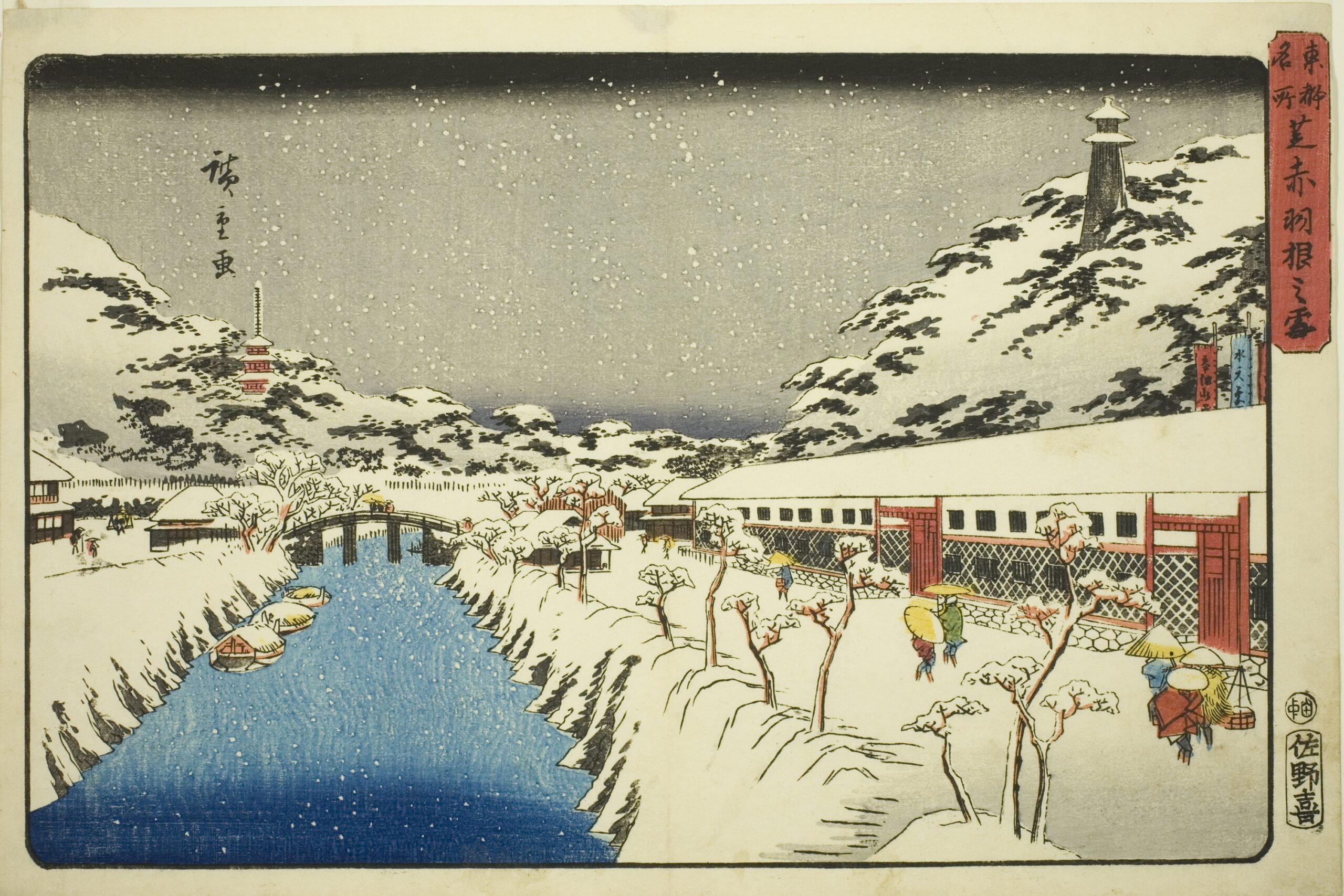
In Hiroshige’s world, snow does not silence life — it softens it.
Winter Scenes by Utagawa Hiroshige
Snow in ukiyo-e is rarely just snow.
In the hands of Utagawa Hiroshige, it becomes a quiet presence — softening sound, slowing movement, and reshaping familiar landscapes.
Hiroshige did not paint winter as harsh or dramatic.
He painted it as a pause in time.
Why Snow Mattered to Hiroshige

For travelers on the Edo-period roads, snow meant delay, discomfort, and uncertainty.
Hiroshige understood this well.
Yet in his prints, snow is not an obstacle.
It is a filter — one that removes noise and leaves only what truly matters:
- footsteps on a road
- rooftops sinking under white weight
- figures moving carefully, deliberately
Snow allows the viewer to breathe.
Kambara: The Most Famous Snowfall
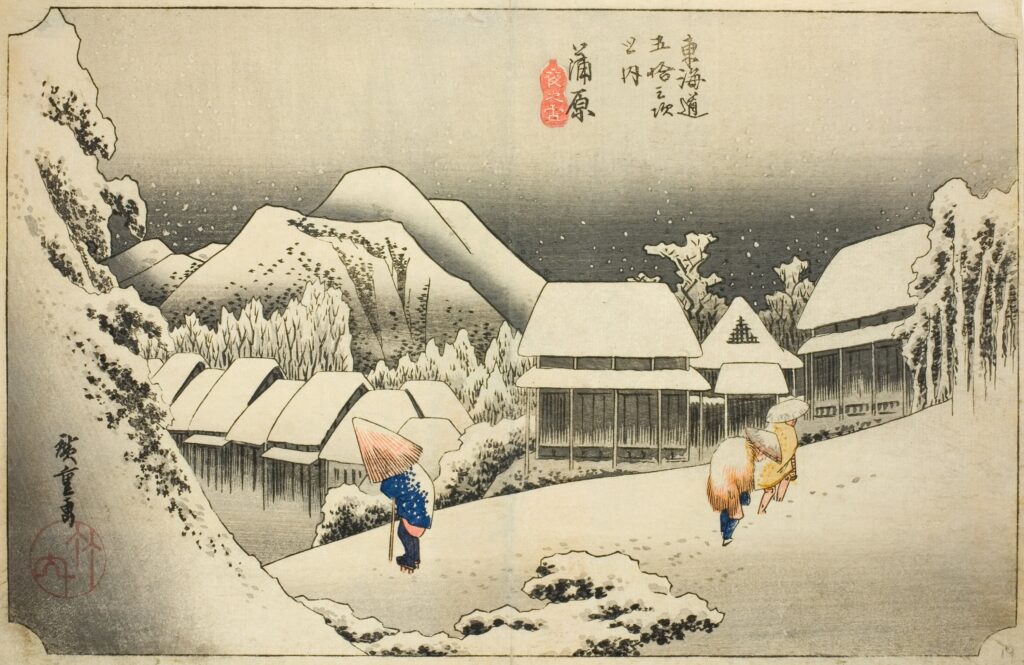
Among Hiroshige’s winter scenes, Kambara from The Fifty-three Stations of the Tōkaidō is perhaps the most iconic.
Dark sky.
Heavy snow.
Small figures walking with bowed heads.
There is no landmark demanding attention.
The landscape itself — muted, reduced, nearly abstract — becomes the subject.
This print feels less like a depiction of a place and more like a memory.
Snow as a Tool of Composition
Hiroshige used snow not just as weather, but as design.
- White areas create silence within the image
- Details are intentionally hidden
- Contrast becomes softer, more emotional
What is not shown is as important as what is shown.
This restraint is what makes his snow scenes feel modern even today.
Winter Without Drama
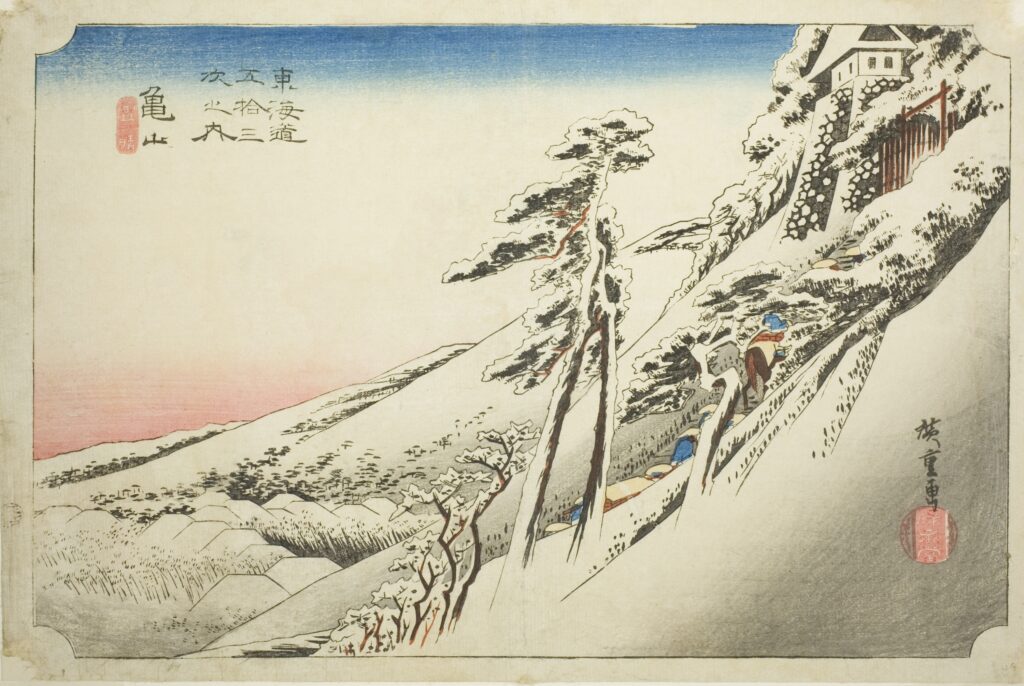
Unlike heroic winter scenes in Western art, Hiroshige’s snow never overwhelms.
People continue walking.
Life continues quietly.
There is no triumph over nature — only coexistence.
In this way, Hiroshige’s winter landscapes feel deeply human.
Seeing Snow Slowly
Snow invites slowness.
When experienced as a jigsaw puzzle or a carefully observed artwork, Hiroshige’s winter scenes reveal themselves gradually —
roof by roof, tree by tree, footprint by footprint.
Nothing rushes.
Nothing demands attention.
Final Thoughts
Hiroshige’s snow teaches us that silence does not mean emptiness.
It means space — for movement, for reflection, for calm.
In his winter landscapes, the world does not stop.
It simply moves more gently.
📌 About the Artwork
- Artist: Utagawa Hiroshige
- Period: Edo period (19th century)
- Theme: Winter landscapes, snow scenes
コメント