
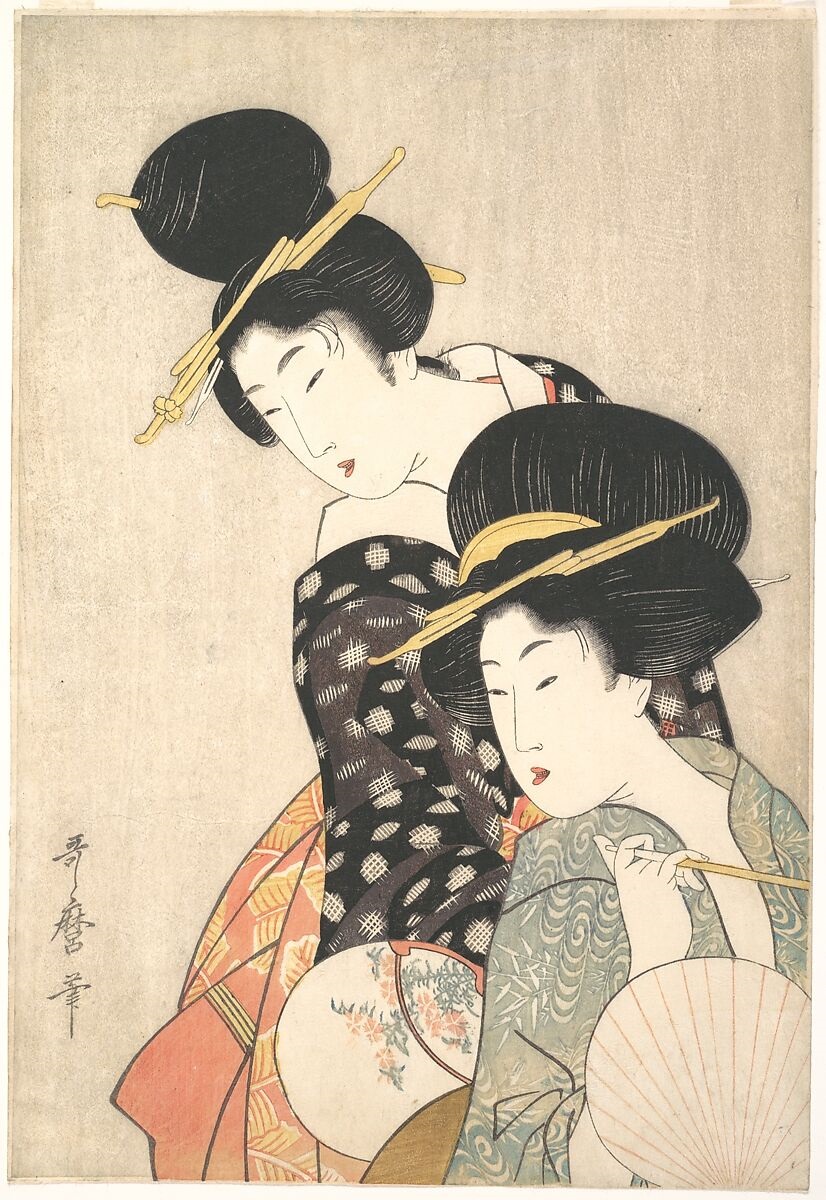
Kitagawa Utamaro is often described as a painter of beautiful women.
But that description is incomplete.
Utamaro did not simply record appearances.
He explored perception — how beauty is seen, sensed, and quietly judged.
In Edo-period Japan, beauty was everywhere.
In teahouses.
On streets.
Behind paper screens.
Yet Utamaro chose not to paint beauty as an object.
He painted it as a moment of awareness.
Beauty That Knows It Is Being Watched
Unlike earlier bijin-ga artists, Utamaro’s women are not distant ideals.
They lean.
They hesitate.
They glance sideways.
Their expressions are subtle, almost private.
A mouth held slightly too long.
Eyes that do not fully meet the viewer.
These women are not passive.
They know they are being seen.
Utamaro’s innovation was psychological.
He turned the viewer into a participant.
Elongation as Intention
Utamaro is famous for elongated necks and narrow faces.
This was not exaggeration for decoration.
The long neck became a space of tension —
between elegance and vulnerability.
Between composure and exposure.
By stretching form, Utamaro slowed the act of looking.
The viewer cannot consume the image quickly.
The gaze lingers.
Edo Society Reflected in Silence
Utamaro’s subjects were often courtesans, entertainers, and women of the pleasure districts.
But his works are not celebrations of luxury.
They are records of atmosphere.
The quiet pressure of reputation.
The fragility of youth.
The exhaustion behind practiced grace.
Utamaro painted what could not be spoken aloud.
Influence Beyond Japan
Utamaro’s work crossed oceans long after his death.
European artists — especially in France — studied his compositions closely.
Flattened space.
Cropped figures.
Emphasis on gesture over narrative.
Modern portraiture owes more to Utamaro than is often acknowledged.
Why Utamaro Still Matters
In a world saturated with images, Utamaro remains relevant because he refused spectacle.
He trusted restraint.
He trusted implication.
His prints remind us that beauty is not loud.
It is perceptive.
And it often reveals more about the viewer
than about the subject itself.
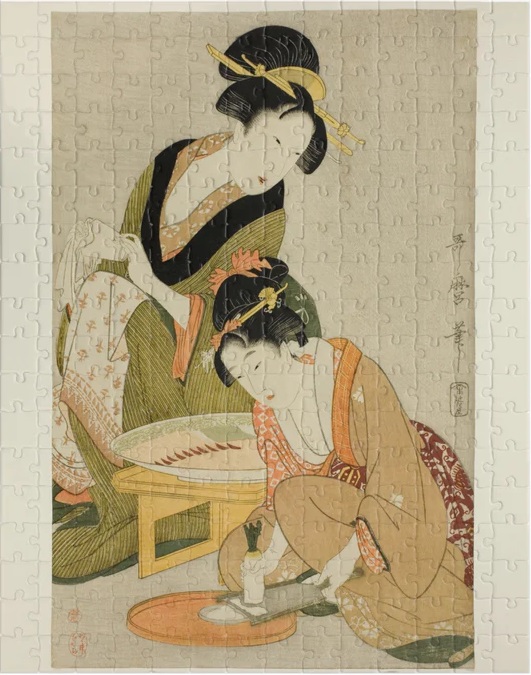
🧩 Experience Utamaro’s works as tangible art
👉 https://jigsawjapan.com


コメント