
The Quiet After the Storm on the Tōkaidō Road
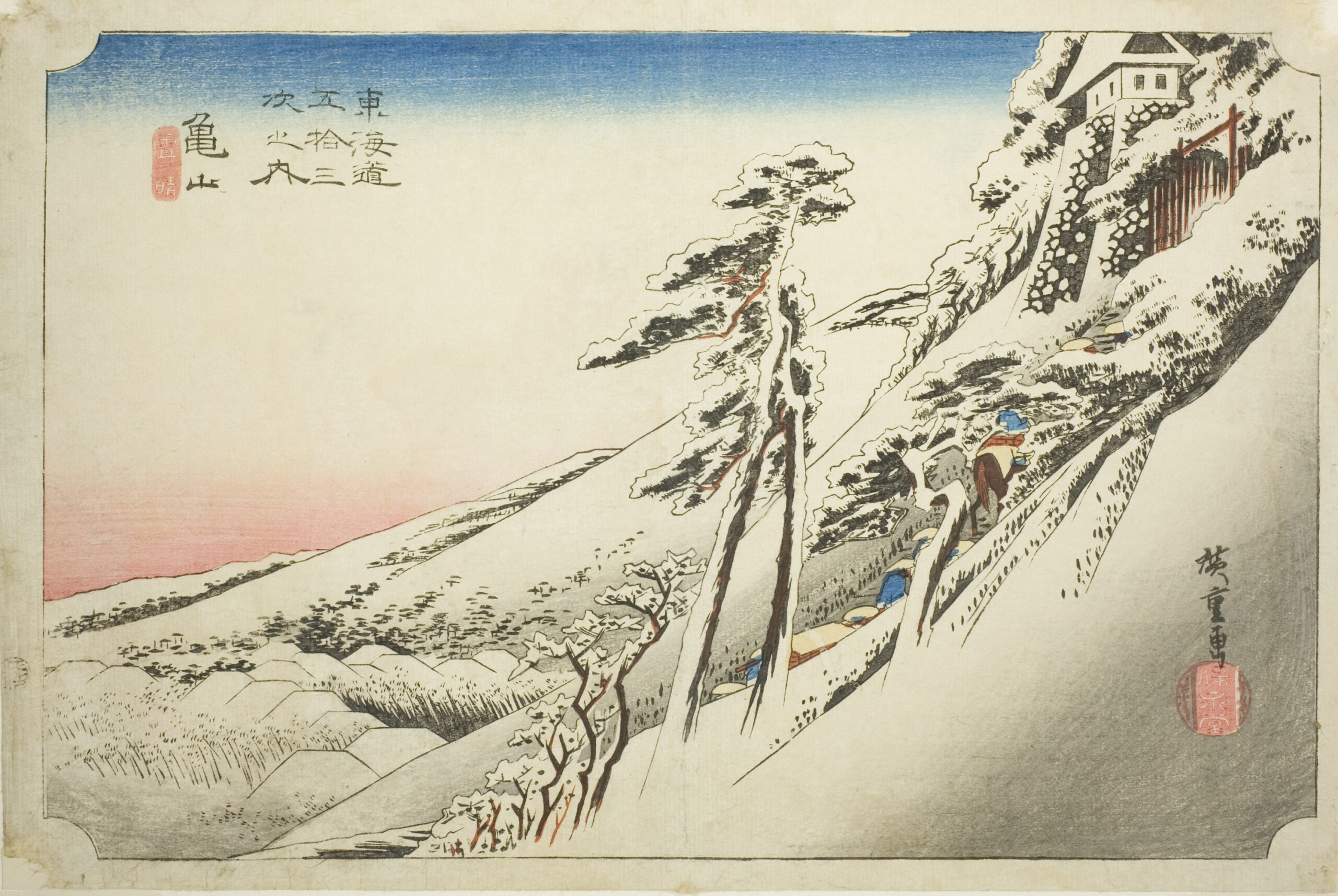
Among the many landscapes created by Utagawa Hiroshige, few capture the subtle atmosphere of winter as beautifully as “Kameyama — Weather Clearing After Snow.”
This print belongs to Hiroshige’s famous series
The Fifty-three Stations of the Tōkaidō,
a collection depicting the landscapes, weather, and daily life along Japan’s historic road connecting Edo (Tokyo) and Kyoto.
While some prints in the series are dramatic — filled with heavy rain, wind, or bustling travelers — this scene is quieter.
It captures a moment after the storm has passed.
The Road Through the Mountains
The setting is Kameyama, a castle town located in present-day Mie Prefecture.
In Hiroshige’s composition, the Tōkaidō road climbs steeply along a mountainside.
Travelers move slowly upward along the winding path.
Some carry luggage or walking sticks.
Others pause briefly on the climb.
Their figures appear small against the winter landscape.
This contrast emphasizes the scale of the surrounding hills and trees.
Snow and the Silence of Winter
The most striking element of the scene is the fresh snow covering the hillside.
Unlike heavy snowstorms depicted in other ukiyo-e works, the snowfall here has already ended.
The sky begins to clear.
Soft light spreads across the landscape.
Tall pine trees stand along the road, their dark trunks rising sharply from the pale snow.
In the distance, the town of Kameyama appears faintly through the winter air.
Hiroshige often used weather not only as a visual effect, but as a way to shape the emotional atmosphere of the journey.
Here, the silence after snowfall creates a sense of calm reflection.
Travelers on the Tōkaidō
During the Edo period, the Tōkaidō Road was the most important highway in Japan.
It connected the political center of Edo with the imperial city of Kyoto.
Thousands of travelers used the road every year.
Samurai on official duty.
Merchants carrying goods.
Pilgrims visiting temples and shrines.
And ordinary people making long journeys between provinces.
Hiroshige’s prints often show these travelers not as individuals, but as small figures within a vast landscape.
The road itself becomes the main character.
Hiroshige’s Vision of Travel
What makes Hiroshige unique among ukiyo-e artists is his ability to depict the atmosphere of a moment.
Rather than focusing on dramatic events, he often captured simple transitions:
Rain beginning to fall.
Evening light fading over water.
Mist rising in the mountains.
Or, as in this print, the quiet moment when snow has just stopped falling.
The journey continues.
But for a brief moment, the world feels still.
A Landscape That Breathes
“Kameyama — Weather Clearing After Snow” reminds us that Hiroshige’s landscapes were never just illustrations of places.
They were studies of weather, distance, and time.
The viewer is not only looking at the road.
They are standing on it.
Feeling the cold air.
Watching the clouds slowly clear.
And walking forward with the travelers into the quiet winter landscape.
📚 Ukiyo-e Library
Exploring the landscapes of Hiroshige and the timeless beauty of Japanese woodblock prints.
🎨 Featured series:
The Fifty-three Stations of the Tōkaidō

コメント