

When Nature Watches Back
Katsushika Hokusai is often remembered for a single image — The Great Wave.
But to see Hokusai only as a painter of waves is to miss his true obsession.
Hokusai did not paint nature as scenery.
He painted nature as a living force — one that observes, reacts, and sometimes threatens those who stand before it.
In Edo-period Japan, mountains were not merely landforms.
The sea was not passive water.
And Mount Fuji was never silent.
Hokusai understood this.
Nature as a Living Presence
Unlike many artists of his time, Hokusai placed humans at the mercy of the world around them.
Fishermen bend under towering waves.
Travelers shrink beside volcanic slopes.
Boats are not heroes — they are fragile.
In The Great Wave off Kanagawa, the wave does not crash randomly.
It curls like a claw.
It pauses, as if deciding.
Mount Fuji, small and distant, remains unmoved — eternal, indifferent, watching.
This tension between movement and stillness defines Hokusai’s work.
配置理由
“Hokusai did not paint waves.He painted moments before disaster.”
The Obsession with Mount Fuji
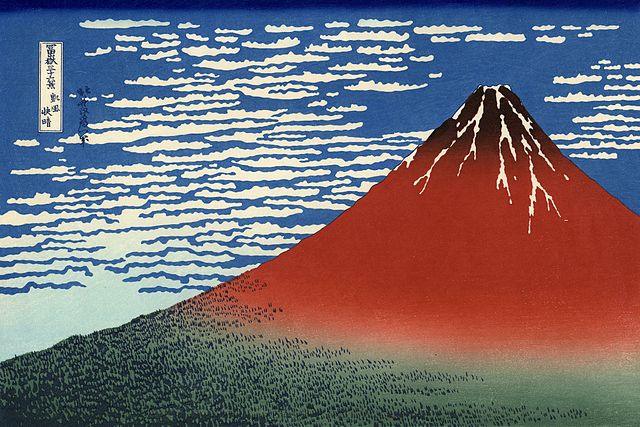
Hokusai returned to Mount Fuji again and again —
Thirty-Six Views, One Hundred Views —
as if repetition itself was a form of worship.
Fuji appears calm, yet unreachable.
It anchors chaos.
Some scholars believe Hokusai saw Fuji not as a mountain,
but as a boundary between worlds —
the human realm and something older.
Whether spiritual or symbolic, Fuji in Hokusai’s work is never neutral.
From Ukiyo-e to Modern Hands
Today, Hokusai’s images survive not only in museums,
but through reinterpretation.
When transformed into a jigsaw puzzle, his compositions reveal new truths:
- The wave must be assembled piece by piece.
- The tension builds slowly.
- The image resists completion.
This mirrors Hokusai’s intent.
Understanding was never instant.
Rebuild Hokusai’s Vision — Piece by Piece
Why Hokusai Endures
Hokusai once said that only at the age of one hundred would he truly become an artist.
He never believed his work was complete.
Perhaps that is why his images feel unfinished —
as if waiting for us to continue them.
To look at Hokusai is to feel watched.
To assemble his work is to participate.
And that may have been his intention all along.

コメント