

More than 200 years have passed since the Edo period,
yet the works of Katsushika Hokusai continue to resonate across cultures and generations.
Hokusai did not simply paint landscapes.
He captured the hidden tension between humans and nature,
revealing a world where beauty and fear quietly
Hokusai Painted the World — Not Just Scenery
Hokusai’s most famous series, Thirty-six Views of Mount Fuji,
is often misunderstood as a simple celebration of Japan’s sacred mountain.
In reality, Mount Fuji is only the anchor.
What Hokusai truly depicted was:
- Violent waves
- Fragile boats
- Ordinary people struggling within overwhelming forces
In The Great Wave off Kanagawa, the sea rises like a living creature.
Humans appear small, almost insignificant.
Nature is magnificent —
but it is never gentle, and never controlled.
Why Hokusai’s Art Feels Unsettling
Many viewers sense something strange in Hokusai’s works.
A subtle discomfort. A quiet unease.
This is no accident.
Hokusai intentionally:
- Shaped waves like claws
- Gave mountains weight and presence
- Used composition to suggest unseen movement
His landscapes feel alive — as if they are watching us.
Hokusai was not illustrating places.
He was revealing a world with its own will.
Why the World Became Obsessed with Hokusai
When Hokusai’s prints reached Europe in the 19th century,
they stunned Western artists.
Van Gogh. Monet. Degas.
They recognized something revolutionary:
👉 Nature was no longer background — it was the main character.
This perspective reshaped modern art.
And it all began with an Edo-period artist who refused to place humans at the center of the universe.
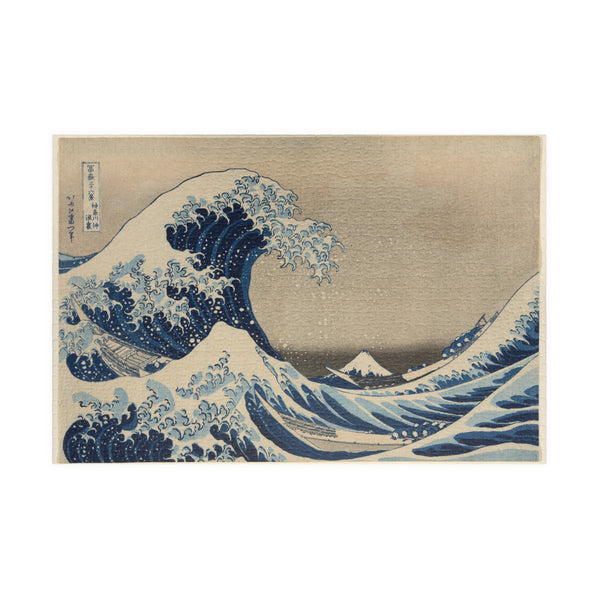
Experiencing Hokusai Through a Jigsaw Puzzle
Hokusai’s art rewards patience.
Each section reveals intention:
the curve of a wave, the distance between figures, the silence of the sky.
That is why jigsaw puzzles are uniquely suited to his work.
As you assemble:
- You search for fragments of motion
- You recognize human fragility
- You watch the world slowly emerge
Completing the puzzle feels less like finishing a product
and more like reconstructing Hokusai’s vision.
Hokusai Is Never Finished
Hokusai believed he would only become a true artist after the age of 100.
His work reflects that belief.
Every time you return to it,
the meaning shifts.
The wave feels higher.
The silence feels deeper.
Where to Go Next
If this world intrigues you, the journey has only begun.
- Hokusai and supernatural forces
- The wave as a living entity
- Hidden symbolism inside Thirty-six Views of Mount Fuji
👉 Continue exploring Hokusai’s world through art, story, and form.
Recommended Internal Links (for Blog Circulation)
- Hokusai and the Supernatural
- Hiroshige vs. Hokusai: Two Views of Nature
- Ukiyo-e Landscapes as Living Worlds
コメント