
Before beauty becomes decoration,
it is observation.
Before a face becomes idealized,
it is studied.
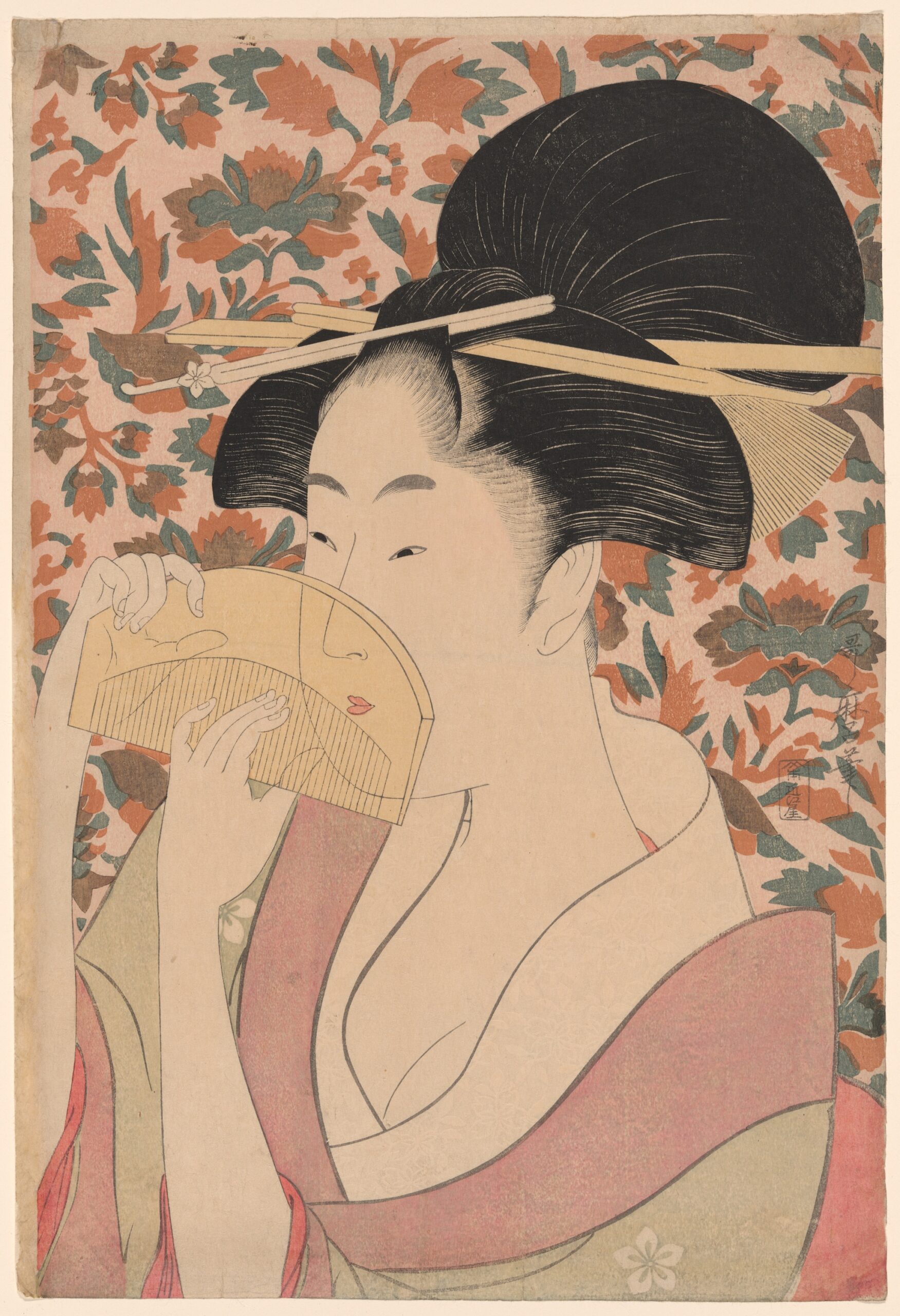
Kitagawa Utamaro did not paint women as symbols.
He painted them as presences.
In late eighteenth-century Edo,
where pleasure districts defined fashion and fantasy,
Utamaro turned his attention inward.
His bijin-ga — “pictures of beautiful women” —
were not merely portraits of courtesans.
They were studies of expression.
A tilt of the head.
A pause before speech.
A hand resting lightly against fabric.
The drama is minimal.
The emotion is subtle.
Unlike earlier depictions of beauty,
Utamaro elongated the figure.
Necks stretch elegantly.
Faces narrow.
Lines refine.
But exaggeration was never the goal.
He reduced the background.
He removed distraction.
In doing so,
he forced attention toward the face.
And in the face,
toward thought.
Utamaro’s women are rarely loud.
They do not command the page with gesture.
They exist in quiet concentration.
Reading a letter.
Preparing cosmetics.
Listening.
These are not heroic acts.
They are human moments.
Edo was a city of spectacle —
kabuki theaters, festivals, commerce, desire.
Yet Utamaro chose intimacy over spectacle.
He captured individuality
within a world built on performance.
There is intelligence in his lines.
Not only technical mastery —
though that is undeniable —
but psychological awareness.
Each print asks a silent question:
Who is she,
beyond what we see?
This subtlety made Utamaro revolutionary.
His women were not interchangeable icons.
They were distinct personalities.
The curve of the eyebrow shifts meaning.
The direction of the gaze changes the story.
Even pattern becomes quiet architecture —
kimono designs balancing the delicacy of skin.
And then there is restraint.
Utamaro understood negative space.
He understood that beauty breathes
when surrounded by emptiness.
Where others filled the frame,
he allowed pause.
In that pause,
the viewer participates.
Centuries later,
his influence remains.
Not because he captured fashion,
but because he captured perception.
Utamaro reminds us that beauty
is not noise.
It is attention.
It is the space between gesture and thought.
It is the intelligence behind the eyes.
In the Ukiyo-e tradition,
fleeting life was the theme.
But Utamaro did something quieter.
He made fleeting expression
feel permanent.
And in doing so,
he transformed beauty
into contemplation.


コメント