
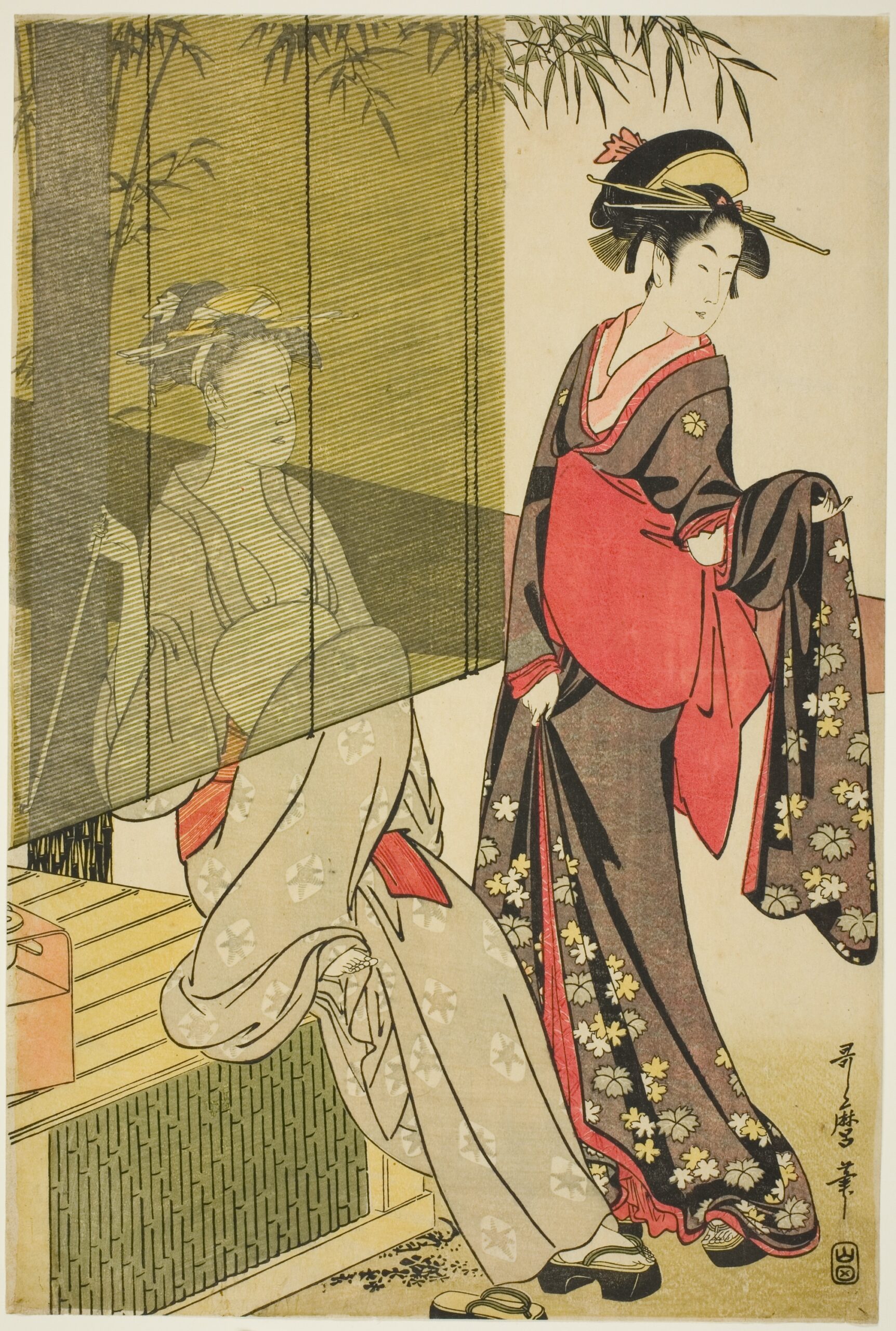
Among the masters of Ukiyo-e, few artists transformed the image of beauty as profoundly as Kitagawa Utamaro.
Working during the late Edo period, Utamaro became famous for his elegant portraits of women, known as bijin-ga — “pictures of beautiful people.”
But Utamaro did not simply paint beauty.
He studied expression.
He observed gesture.
He explored personality.
The Art of the Face
Before Utamaro, many ukiyo-e prints showed women in full figures, surrounded by elaborate clothing and decorative settings.
Utamaro changed this approach.
He moved closer.
His portraits often focus on the face and upper body, allowing subtle expressions to emerge.
A slightly lowered eyelid.
A delicate tilt of the head.
The quiet curve of a hand adjusting hair.
Through these small details, Utamaro revealed individuality within a world that often idealized beauty.
Each woman feels present —
not simply as an image,
but as a moment in life.
The Floating World of Edo
Utamaro worked in the vibrant cultural environment of Edo, a city that had become one of the largest urban centers in the world.
The pleasure districts, particularly Yoshiwara, were famous for theater, poetry, fashion, and the refined culture of courtesans.
Artists like Utamaro documented this world.
Yet his work rarely feels loud or theatrical.
Instead, it captures quiet moments:
A woman reading a letter.
Another arranging her hair.
A glance toward a passing thought.
These scenes belong to everyday life within the floating world.
A Master of Subtle Emotion
Utamaro’s prints are admired not only for their beauty but for their psychological depth.
Where other artists emphasized costume and decoration, Utamaro emphasized emotion and character.
His women appear thoughtful, introspective, and alive.
The result is an extraordinary sense of intimacy.
Even centuries later, viewers often feel as if they are sharing a private moment with the subject.
Legacy in Japanese Art
Today, Utamaro is considered one of the greatest portrait artists in Japanese history.
His prints influenced generations of artists and became highly admired in Europe during the era of Japonisme in the 19th century.
Collectors and scholars continue to study his work for its elegance, composition, and emotional subtlety.
But perhaps Utamaro’s greatest achievement is simple.
He transformed portraiture.
Through quiet observation and refined line, he showed that beauty could be more than appearance.
It could reveal a moment of humanity.
The Stillness Within Beauty
In the world of ukiyo-e, landscapes often capture journeys and changing seasons.
Utamaro chose a different path.
He explored the landscape of the human face.
And within those quiet portraits, he discovered something timeless:
Beauty not as spectacle —
but as presence.
🎨 Ukiyo-e Landscape Journal
Exploring the artists, stories, and quiet atmospheres of Japan’s floating world.


コメント