
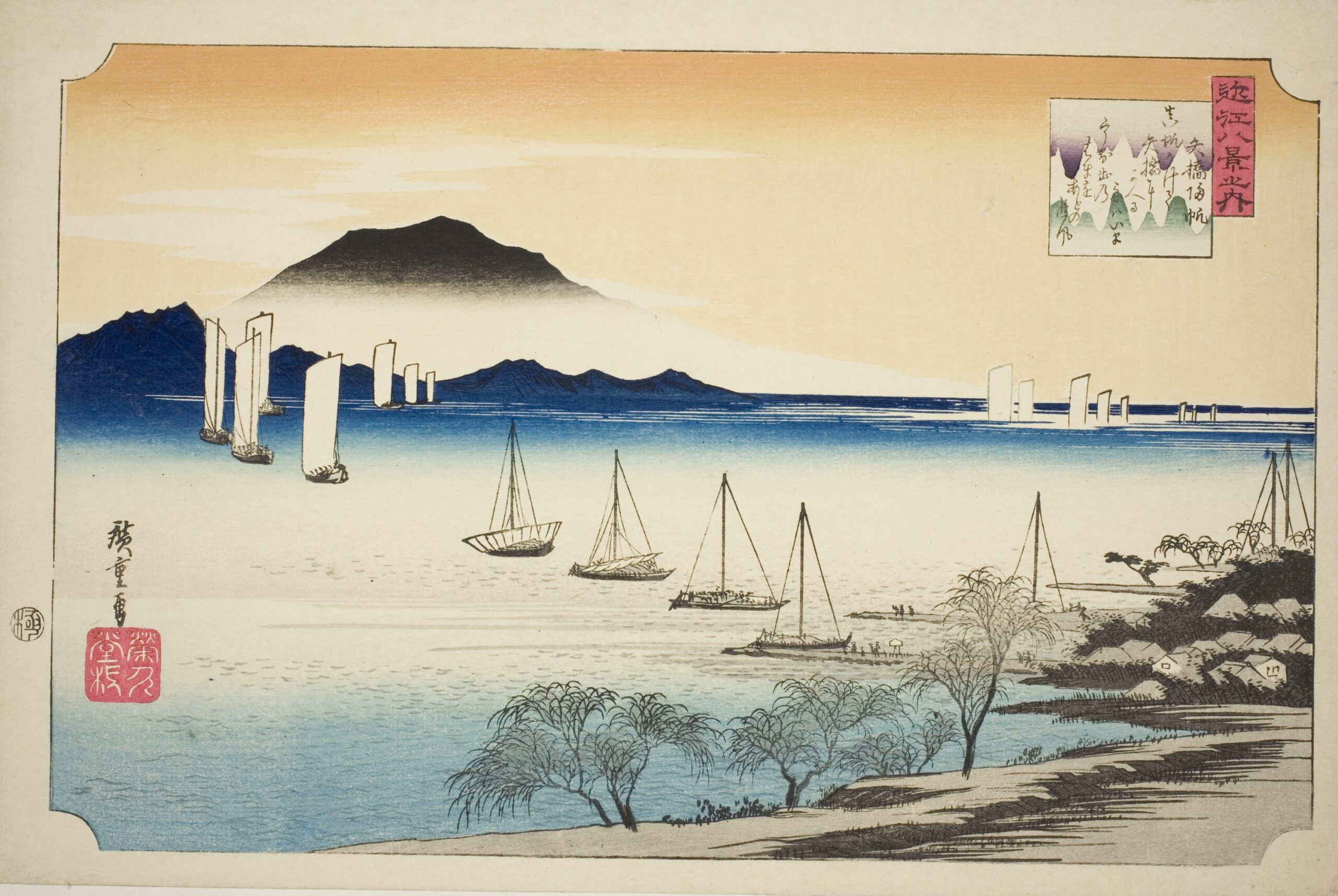
Among the great masters of Japanese woodblock printing, few artists captured atmosphere and emotion as gently as Utagawa Hiroshige. While many artists of the Edo period focused on dramatic scenes or theatrical subjects, Hiroshige found inspiration in quieter moments—mist rising over rivers, travelers crossing bridges, or distant mountains fading into evening light.
Born in Edo (modern Tokyo) in 1797, Hiroshige lived during a time when travel across Japan was expanding rapidly. Roads such as the Tōkaidō connected cities and provinces, allowing merchants, pilgrims, and officials to move between regions. These journeys became the foundation of Hiroshige’s artistic vision.
Rather than portraying travel as heroic adventure, Hiroshige showed the rhythm of movement itself: people walking beneath rain, boats drifting across wide lakes, and small villages resting along long roads.
One of his most celebrated series is The Fifty‑Three Stations of the Tōkaidō, where each print depicts a different stop along the famous highway connecting Edo and Kyoto. In these images, the landscape often dominates the composition while human figures remain small, reminding the viewer that nature is larger and more enduring than human activity.
Another poetic body of work is the Eight Views of Ōmi, inspired by classical Chinese landscape traditions. In this series, Hiroshige explores the changing moods of Lake Biwa, Japan’s largest lake. Each scene corresponds to a specific time of day or natural phenomenon—autumn moonlight, evening bells, returning sails, or sunset glowing across the water.
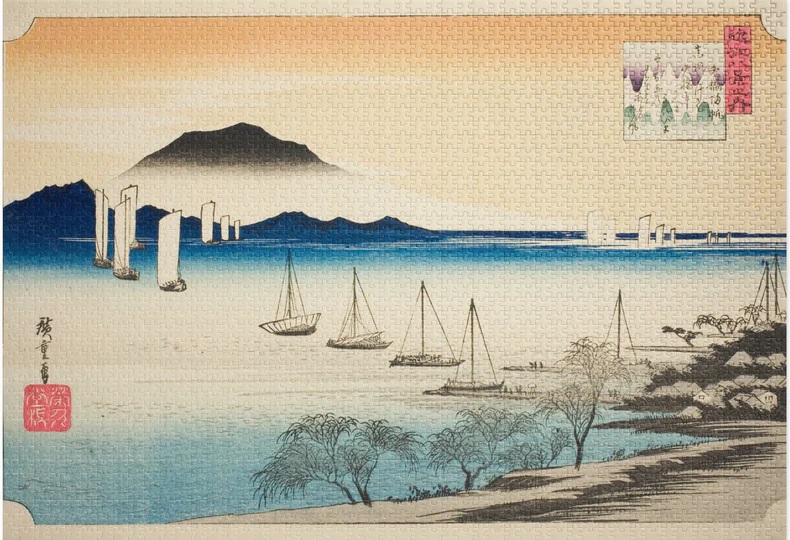
What makes Hiroshige’s work unique is his understanding of atmosphere. Clouds drift softly across his skies. Rain falls in delicate diagonal lines. Distant mountains fade into pale gradients of color. These subtle techniques create a feeling of depth and silence rarely seen in earlier ukiyo-e prints.
While artists like Katsushika Hokusai often emphasized dynamic power and bold composition, Hiroshige favored balance, distance, and calm observation. His landscapes feel less like dramatic scenes and more like moments of quiet reflection.
This sensitivity to weather and mood influenced many artists beyond Japan. When Japanese prints reached Europe in the nineteenth century, painters such as Vincent van Gogh and Claude Monet admired the clarity and composition of ukiyo-e. Hiroshige’s treatment of light, perspective, and atmosphere helped inspire new approaches to landscape painting in the West.
Yet the true strength of Hiroshige’s work lies in its stillness. His prints rarely shout for attention. Instead, they invite the viewer to pause—to watch the movement of clouds, the flow of water, or the quiet passage of travelers along a distant road.
More than two centuries later, these landscapes continue to resonate. They remind us that beauty is often found not in grand events, but in the simple rhythm of nature: a bridge over calm water, a boat returning home, or the soft glow of evening settling over the land.
In the world of ukiyo-e, Hiroshige did not merely illustrate Japan.
He allowed us to feel it.

コメント