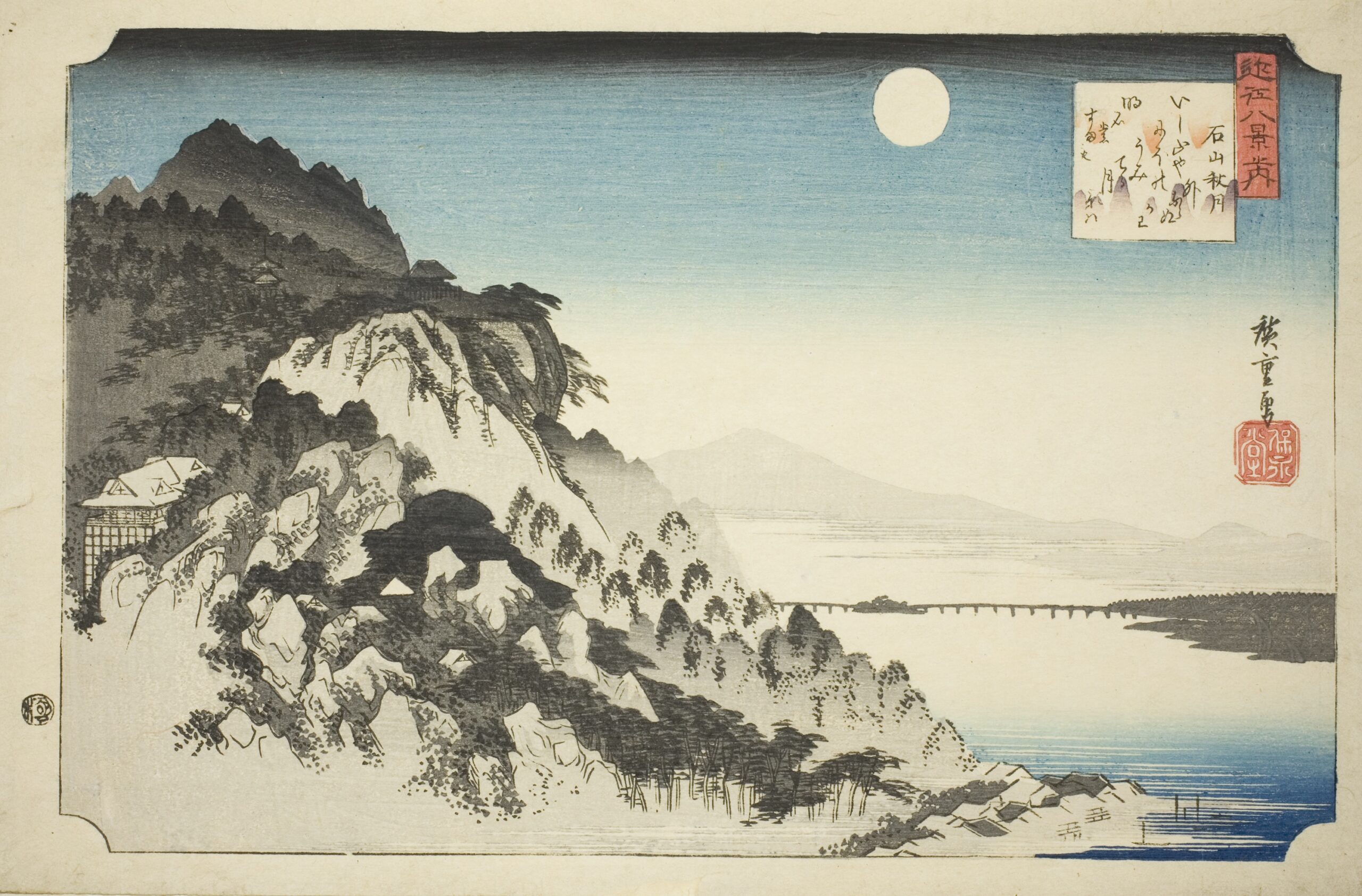
Among the masters of ukiyo-e, Utagawa Hiroshige stands apart for one quiet reason:
he painted weather as emotion.
Where others emphasized heroes, actors, or dramatic waves, Hiroshige turned his attention to roads, rain, snow, and distant mountains. His art does not shout. It listens.
The Journey as Subject
In series such as The Fifty-three Stations of the Tōkaidō, Hiroshige transformed travel into poetry. The Tōkaidō road connected Edo and Kyoto — a physical highway, but also a symbolic passage through seasons, labor, and time.
Travelers bend under wind.
Horses move through mist.
Villages appear briefly, then dissolve into distance.
Nothing spectacular happens.
And yet, everything feels alive.
Hiroshige understood something profound: movement itself is the story.
Rain That Moves Diagonally
In Sudden Shower over Shin-Ōhashi Bridge and Atake, rain does not fall vertically. It cuts across the image in sharp diagonal lines. The figures hurry forward, straw hats pulled low.
The rain is not background — it is structure.
This compositional choice creates urgency without chaos. The viewer feels the storm but also the rhythm of it. Nature is powerful, but not violent. Temporary, not destructive.
That balance is Hiroshige’s signature.
Snow as Stillness
Compare that with his winter scenes. Snow in Hiroshige’s prints softens the world. Sound seems absorbed. The air becomes heavy and calm.
Unlike the towering force of Katsushika Hokusai, Hiroshige’s landscapes rarely dominate the viewer. Instead, they invite quiet participation.
You are not overwhelmed.
You are present.
The Power of Space
One of Hiroshige’s greatest strengths is negative space.
Sky occupies large portions of his compositions. Water stretches wide and uncluttered. Figures appear small against vast environments.
This scale shift places humanity within nature, not above it.
It is a gentle philosophy:
we move through the world —
we do not control it.
Influence Beyond Japan
Hiroshige’s prints deeply influenced European Impressionists. Artists such as Claude Monet and Vincent van Gogh studied his use of flat color, cropping, and atmospheric perspective.
Van Gogh even copied some of his prints directly.
What fascinated Western painters was not just the imagery —
it was the perspective.
Hiroshige framed scenes as if glimpsed in passing. A branch cuts across the foreground. A bridge enters at an unexpected angle. The composition feels immediate, almost photographic.
Modern.
Why Hiroshige Still Matters
In a world saturated with speed and spectacle, Hiroshige offers something rare:
continuity.
He reminds us that daily life — walking, waiting, traveling — contains quiet beauty. Weather is not interruption; it is atmosphere. Distance is not emptiness; it is possibility.
His art does not demand attention.
It earns it slowly.
A Quiet Library
To study Hiroshige is to slow down. Each print becomes less an object and more a pause — a moment between destinations.
Perhaps that is why his work feels timeless.
Because roads continue.
Rain continues.
Snow continues.
And we continue walking through them.

コメント