
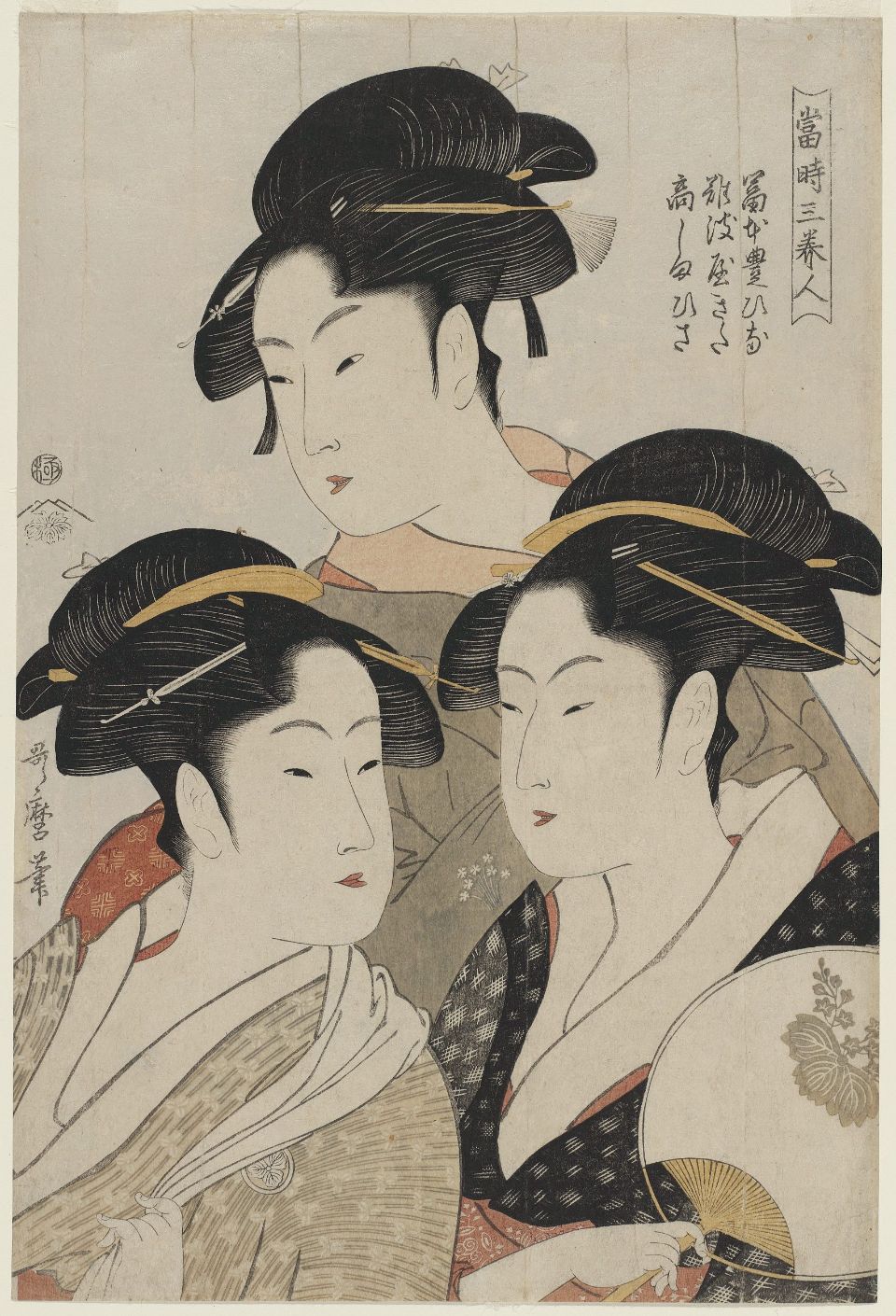
In the refined yet restless world of Edo-period Japan, beauty was not merely decoration — it was observation, tension, and presence. Among all ukiyo-e masters, Kitagawa Utamaro stands apart for the way he transformed female portraits into psychological landscapes.
Utamaro did not simply depict women.
He studied how beauty exists when it is seen.
Beauty Seen Too Closely
Utamaro is best known for his bijin-ga (pictures of beautiful women), especially his bold use of ōkubi-e — large head-and-shoulder portraits that push the viewer uncomfortably close.
At this distance, beauty becomes unstable.
- A smile lingers a fraction too long
- Eyes seem aware of being watched
- Fingers hesitate, mid-gesture
These women are not passive muses. They notice you.
This psychological tension is what gives Utamaro’s work its modern quality. Long before photography or cinema, he understood framing, proximity, and the power of gaze.
The World Behind the Faces
Utamaro lived and worked in late 18th-century Edo, a city obsessed with fashion, pleasure districts, and fleeting trends. Many of his subjects were courtesans and entertainers from Yoshiwara, yet his portrayals go beyond status or costume.
He captured:
- Subtle differences in personality
- Emotional states suggested through posture
- Individuality within an idealized form
Rather than repeating a single “ideal face,” Utamaro explored variation — a radical idea in an era of stylization.
Why Utamaro Still Feels Unsettling
Modern viewers often describe Utamaro’s women as:
- Too perfect, yet slightly off
- Calm, but not peaceful
- Beautiful, yet watchful
This is not accidental. Utamaro’s genius lies in ambiguity. His prints do not tell stories outright — they invite interpretation.
Are these women aware of their role?
Do they resent the gaze?
Or do they control it?
Utamaro never answers.
Utamaro as a Jigsaw Puzzle Experience
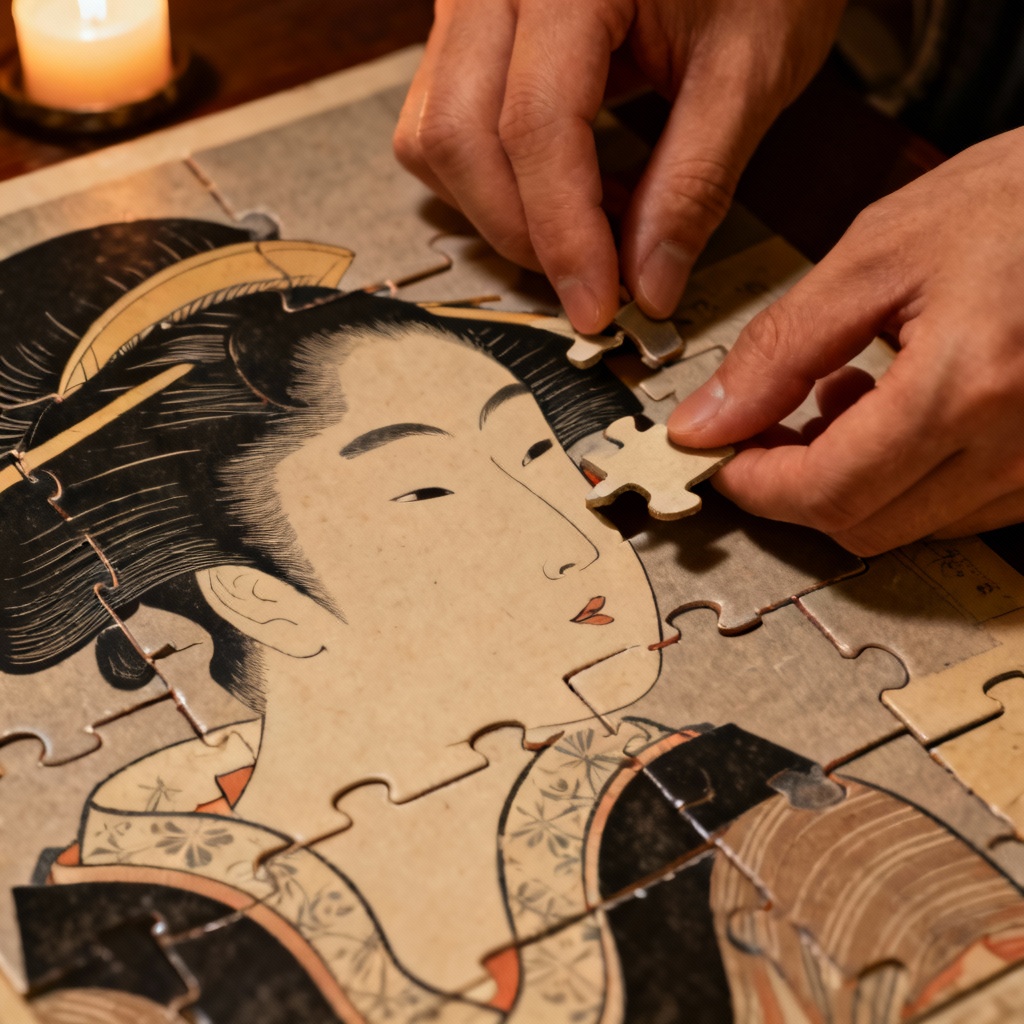
When Utamaro’s works are recreated as jigsaw puzzles, this psychological depth becomes tactile.
Piece by piece, the viewer:
- Reconstructs a gaze
- Follows the curve of a neck or hairline
- Gradually reveals expression and mood
The act of assembling mirrors Utamaro’s own process — careful, intimate, and attentive. The finished image feels less like a picture and more like a presence.
Legacy of a Silent Observer
Kitagawa Utamaro’s influence extends far beyond ukiyo-e. His approach to portraiture anticipates modern illustration, fashion photography, and even psychological cinema.
He reminds us that beauty is not static.
It reacts.
It observes.
And sometimes — it watches back.


コメント