
Hokusai’s Quiet Vision in Snowy Morning at Koishikawa
In the vast body of work created by 葛飾北斎, there are images that roar — and images that whisper.
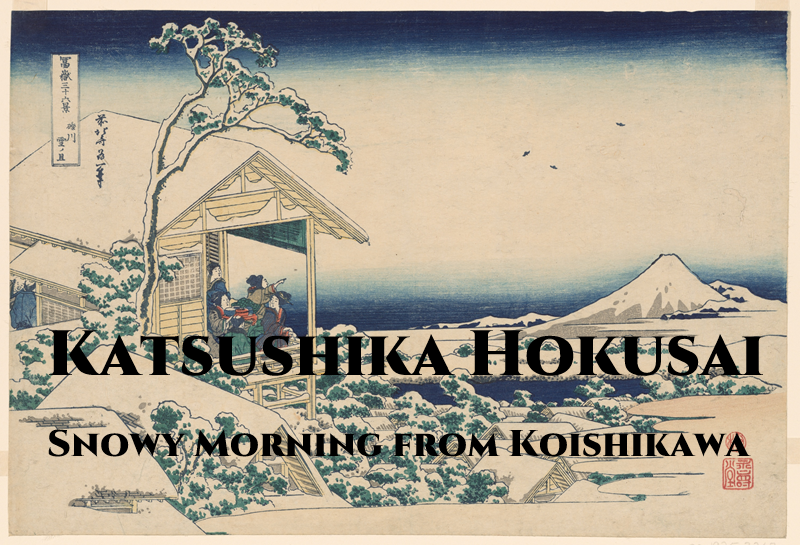
When people think of Hokusai, they often recall towering waves or blazing skies. Yet within his celebrated series Thirty-Six Views of Mount Fuji, there are moments of remarkable stillness. Snowy Morning at Koishikawa is one of them.
Here, the world is hushed.
❄️ A Winter Morning Suspended in Time
Snow covers the rooftops of Koishikawa.
The weight of white softens angles and edges.
Trees bend gently, as if bowing to the season.
In the foreground, a small elevated pavilion shelters several figures. They gather not in urgency, but in warmth. One points outward — toward the horizon.
And there, beyond the town, stands Mount Fuji.
It does not dominate the scene.
It does not demand attention.
It simply exists.
Hokusai’s genius lies in restraint. Fuji is distant, yet emotionally central. Human life unfolds in the foreground, enclosed in wooden architecture and layered garments. Meanwhile, the mountain remains untouched — quiet and eternal.
🗻 Everyday Life and the Eternal
Unlike The Great Wave, this print carries no visible tension. There is no dramatic weather, no violent motion. Instead, we see contrast:
- The temporary nature of snow
- The warmth of shared human presence
- The permanence of the mountain
Snow will melt.
Conversations will end.
Roofs will darken again.
But Fuji remains.
This balance between the fleeting and the eternal is at the heart of Hokusai’s vision. He was not merely documenting scenery — he was observing time itself.
🎨 Composition and Perspective
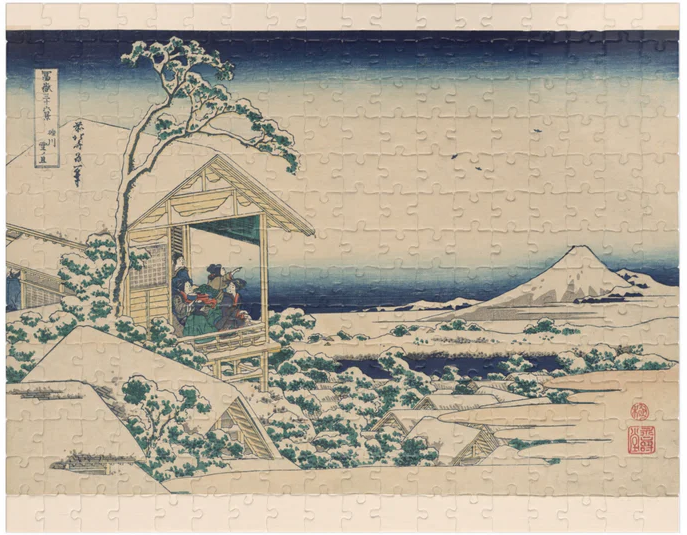
Notice how the pavilion frames the viewers inside the scene. We look past the figures, through the open structure, toward the distant landscape. The architecture acts almost like a stage, gently guiding the eye outward.
Hokusai often used bold compositional devices — bridges, frames, circles, or diagonal lines — to lead the viewer toward Mount Fuji. In this print, the framing is subtle, architectural, human.
The scene invites us to pause.
There is no spectacle.
Only balance.
🌿 Why This Image Still Matters
In a world of constant motion, this print feels unexpectedly modern. It speaks of:
- Slowness
- Observation
- Quiet companionship
- Perspective
It reminds us that not every powerful image needs to be loud. Some of Hokusai’s most profound works are those where he lowers his voice.
Snowy Morning at Koishikawa is not about winter alone. It is about distance — the emotional space between daily life and something larger.
And perhaps that is why Mount Fuji appears again and again in his series. Not as an interruption, but as a constant.
🧩 From Print to Puzzle — Reassembling Stillness
At Jigsaw Japan, we revisit works like this not simply as images, but as experiences. Reconstructing a Hokusai composition piece by piece allows us to inhabit its rhythm — its quiet geometry and layered space.
To assemble a winter scene slowly is to rediscover patience.
Hokusai understood something timeless:
Human life moves in seasons.
The mountain does not.
And in that contrast, there is peace.


コメント