
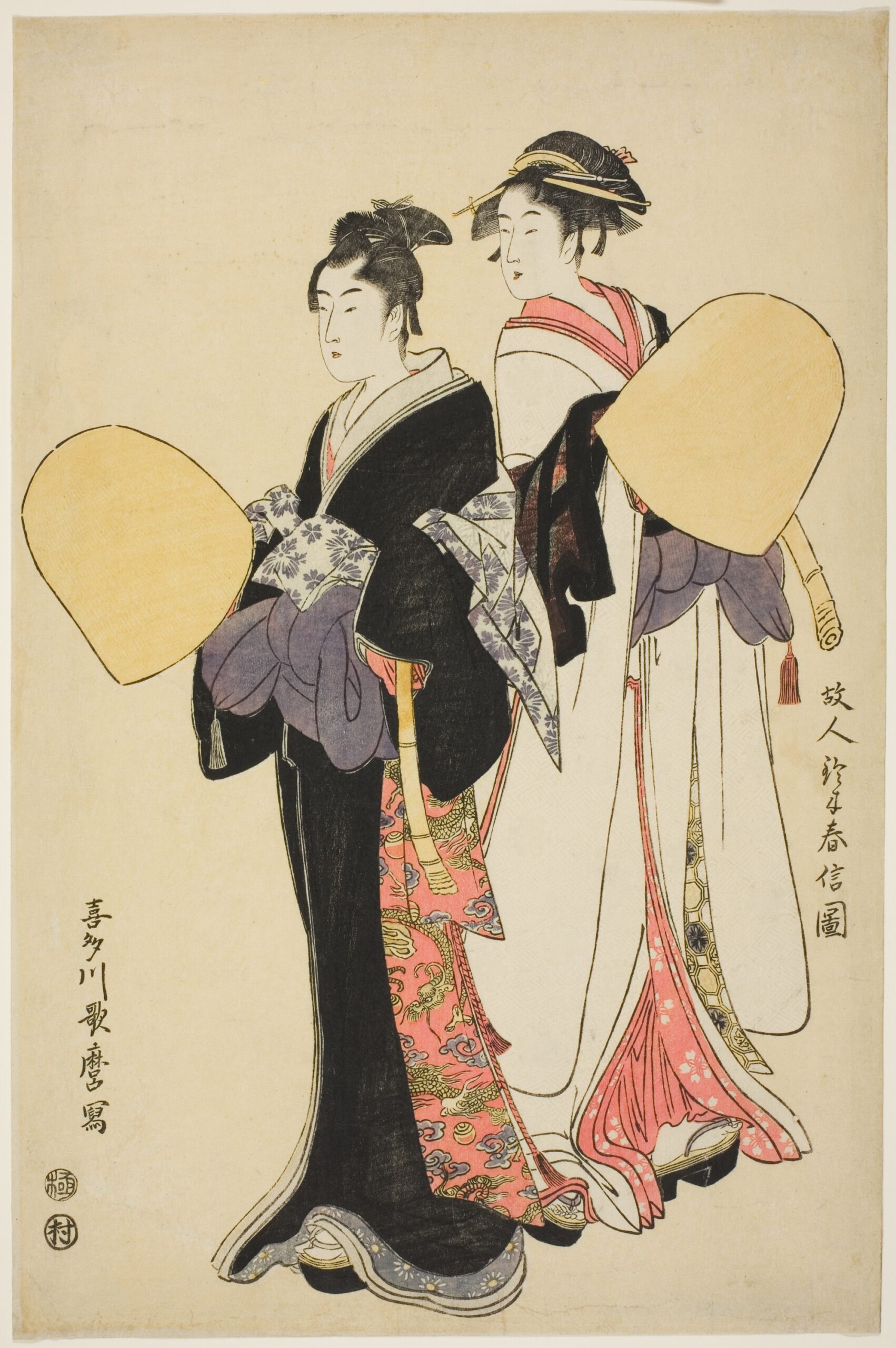
In the world of ukiyo-e, where landscapes often stretch across rivers and roads,
Kitagawa Utamaro chose a different path.
He looked not outward, but inward —
toward the subtle expressions of human presence.
Utamaro became known for his bijin-ga,
portraits of women that captured more than appearance.
They revealed something quieter.
A gesture.
A glance.
A moment between thoughts.
A Study of Presence
Unlike the dramatic scenes of warriors or actors,
Utamaro’s work feels intimate.
His subjects are often shown in close view —
their faces slightly turned,
their hands gently resting,
their attention caught somewhere unseen.
There is no urgency in these compositions.
No grand narrative.
Only a quiet observation of life as it unfolds.
And in that stillness,
something deeply human begins to emerge.
Beyond Beauty
While his works are often described as images of beauty,
Utamaro’s vision goes further.
He explores individuality.
Each woman is distinct —
not simply an ideal,
but a presence with her own mood, her own world.
Through delicate lines and subtle variations,
he suggests emotion without declaring it.
A lowered gaze.
A faint smile.
A moment of reflection.
These are not portraits of perfection.
They are portraits of being.
A Changing World
Utamaro worked during the late Edo period,
a time when urban culture flourished.
The floating world — ukiyo —
was filled with theaters, teahouses, and fleeting pleasures.
Yet within this vibrant setting,
Utamaro’s work feels restrained.
He does not capture the noise.
He captures what remains after it.
A pause.
A quiet space between encounters.
The Art of Subtlety
What makes Utamaro enduring is not scale or spectacle,
but sensitivity.
His prints invite us to slow down.
To notice small details —
the curve of a line,
the softness of expression,
the silence within the image.
In a world that moves quickly,
his work offers something rare.
A moment to look,
and to feel… without explanation.
A Lasting Impression
Kitagawa Utamaro’s legacy is not defined by grandeur,
but by presence.
His work reminds us that beauty does not always announce itself.
Sometimes, it appears quietly —
in the way a figure turns,
or in the space between two thoughts.
And in that quiet,
we are invited to see not only the subject,
but ourselves.
🌿 Ukiyo-e Library
Quiet studies of beauty, presence, and the human moment.
Where art does not speak loudly —
but lingers.

コメント