

Among the many masters of ukiyo-e, few figures remain as mysterious as Tōshūsai Sharaku.
In the long history of Japanese woodblock prints, Sharaku appeared suddenly, created a remarkable body of work, and then vanished just as quickly.
His career lasted only about ten months between 1794 and 1795.
Yet during that brief moment, Sharaku produced some of the most powerful portraits ever seen in Japanese printmaking.
Most ukiyo-e artists of the Edo period sought elegance and beauty in their subjects.
Sharaku did something entirely different.
He revealed character.
The Theater of Edo
Sharaku focused almost entirely on portraits of kabuki actors.
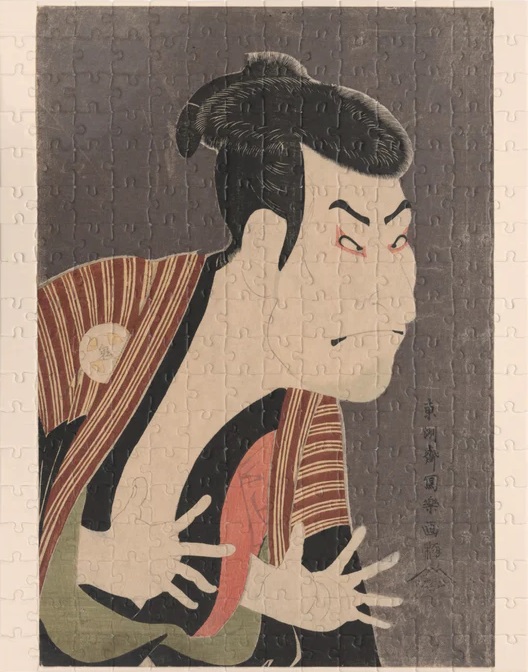
These prints captured performers during dramatic moments on stage, portraying them in exaggerated poses, with expressions full of tension and emotion.
Kabuki theater was one of the great entertainments of Edo society.
Audiences were fascinated by famous actors, and prints of performers were widely sold as souvenirs and collectibles.
But Sharaku’s portraits did not flatter the actors.
Instead, he showed them as human beings—sometimes proud, sometimes arrogant, sometimes intense or even uneasy.
This psychological realism made his work very different from the typical actor prints of the time.
A New Kind of Portrait
In Sharaku’s prints, the faces of actors dominate the composition.
Eyes narrow, brows tighten, mouths twist with dramatic force.
These are not merely images of performers in costume.
They are studies of personality.
Sharaku captured the moment between performance and identity—the instant when an actor’s mask slips slightly, revealing the person beneath the role.
This bold style shocked some viewers of the time.
The public, accustomed to more idealized images, did not always appreciate such honesty.
The Mystery of Sharaku
After producing around 140 prints, Sharaku disappeared.
No records clearly explain who he was or why his work ended so abruptly.
Some historians believe he may have been connected to the world of theater itself, perhaps even an actor observing his colleagues with unusual insight.
Others have suggested that Sharaku might have been a pseudonym used by another artist.
To this day, his true identity remains unknown.
Rediscovery and Legacy
During the Edo period, Sharaku’s prints were not widely celebrated.
But centuries later, art historians and collectors began to recognize their extraordinary originality.
Today, Sharaku is considered one of the greatest portrait artists in the history of Japanese art.
His works are admired not only for their dramatic compositions but also for their psychological depth.
They remind us that ukiyo-e was never only about beautiful landscapes or elegant courtesans.
It could also explore the complexity of human expression.
A Moment That Still Speaks
Sharaku’s brief career left behind a legacy that continues to fascinate viewers around the world.
His prints do not simply show actors of the Edo stage.
They capture something timeless—the tension between appearance and identity.
In Sharaku’s world, the theater does not end when the curtain falls.
The faces remain.
The expressions linger.
And through them, the drama continues.
コメント