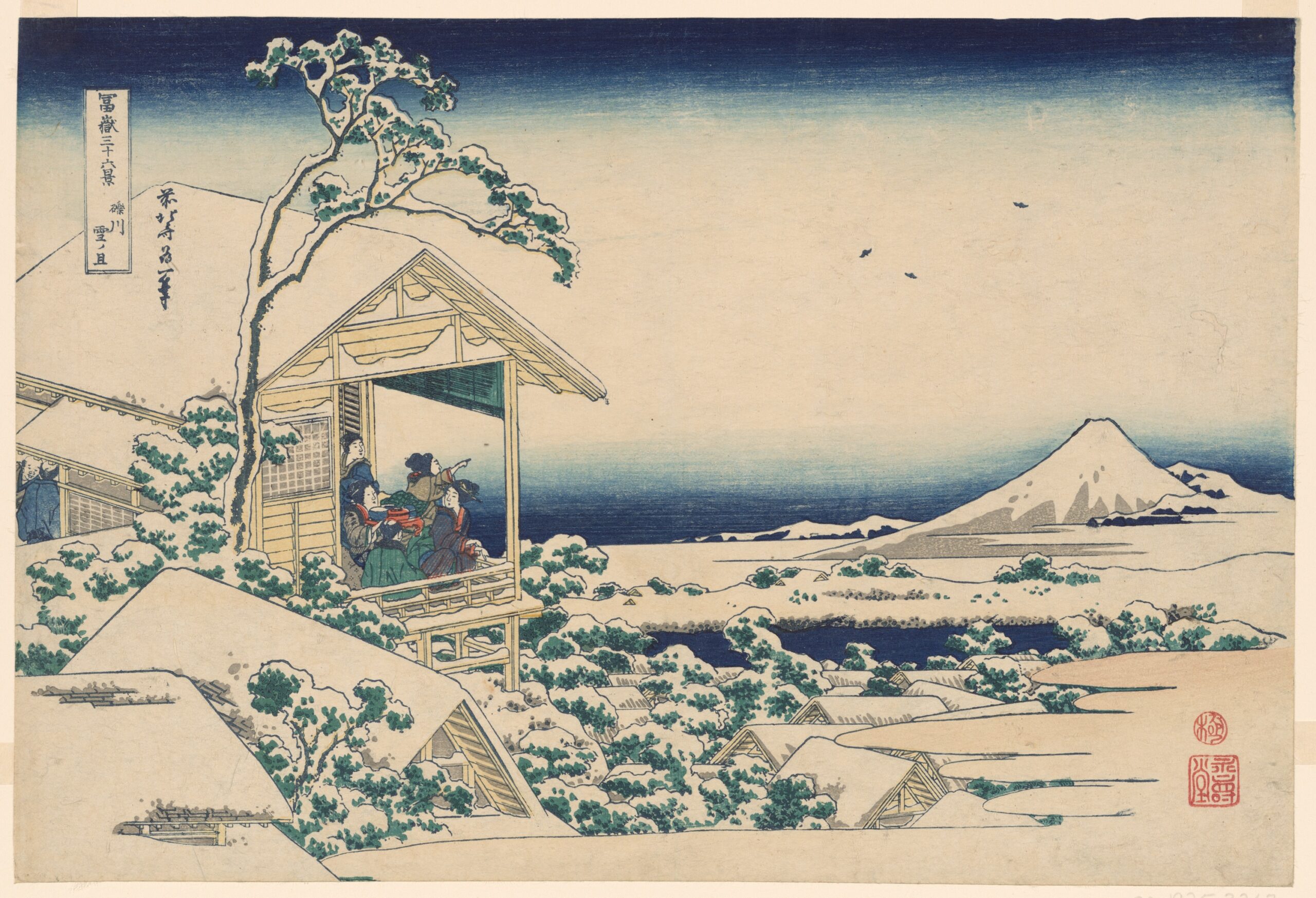
If a single image could hold time itself,
what would it look like?
A river moving quietly through a town.
A fragile boat caught in motion.
Mount Fuji standing in the distance.
Everything changes —
except what does not.
This tension between movement and permanence defines the work of Katsushika Hokusai.
The Wave and the Mountain
In The Great Wave off Kanagawa, the sea rises violently, frozen at the instant before collapse. Fishermen brace themselves beneath its claw-like crest. The scene feels urgent — unstable.
Yet beyond the chaos stands Mount Fuji.
Small.
Still.
Unmoved.
The drama belongs to the wave.
The permanence belongs to the mountain.
Hokusai understood that human life unfolds in turbulence, while something deeper remains unchanged. His Fuji is not simply geography — it is continuity. It is endurance.
The Quiet Power of Red Fuji
In Fine Wind, Clear Morning — often called “Red Fuji” — there is no spectacle. No crashing water. No crowded foreground.
Only a mountain.
Only sky.
But within that simplicity lies immense strength.
Hokusai did not need excess to create impact. The mountain glows with quiet authority, suggesting that presence can be more powerful than noise.
It is not dramatic.
It is inevitable.
Reinvention at Seventy
Hokusai produced his most celebrated works in his seventies. He changed his name multiple times throughout his life, each shift marking artistic rebirth.
Even in old age, he reportedly said that he had not yet reached true mastery — that perhaps by one hundred, he might begin to understand the essence of form.
This relentless pursuit of growth defines him.
Not fame.
Not repetition.
But evolution.
What Remains
Hokusai did not merely document landscapes.
He reframed how humans exist within them.
People in his prints are rarely heroic. They are small, passing figures — farmers, fishermen, travelers — living beneath a larger sky.
The mountain endures.
The wave dissolves.
The moment passes.
But the balance between them remains.
More than two centuries later, Hokusai’s images still feel contemporary — not because they are loud, but because they are balanced.
He painted motion.
He painted stillness.
And between them, he painted eternity.
📚 Ukiyo-e Library
A slow archive of Japanese woodblock prints —
where everyday life meets something larger than time.

コメント