In the world of Ukiyo-e, few artists understood atmosphere the way Utagawa Hiroshige did.
If Hokusai gave us power, structure, and bold presence, Hiroshige gave us distance — and breath.
Where others captured events,
Hiroshige captured conditions.
Rain falling at an angle.
Snow gathering without sound.
Mist dissolving the edge of a bridge.
A traveler pausing before continuing down a narrow road.
His work does not shout.
It recedes.
The Road as Experience
Hiroshige’s most celebrated series, The Fifty-Three Stations of the Tōkaidō, is not merely a record of geography.
It is a record of movement.
The road between Edo and Kyoto becomes something more than a route —
it becomes a rhythm.
Figures are often small.
Sometimes almost secondary.
They walk through rainstorms, across wooden bridges, beneath leaning trees.
Nature is not background — it is participant.
In many prints, Mount Fuji appears only faintly,
partially obscured by cloud or distance.
Unlike the monumental Fuji of Hokusai, Hiroshige’s Fuji often feels far away —
not dominant, but present.
A reminder.
Not a declaration.
Weather as Emotion
Hiroshige mastered the portrayal of rain.
Diagonal lines slicing the air.
Umbrellas tilted against wind.
Paths turning reflective under sudden showers.
He understood that weather changes perception.
Snow quiets a village.
Mist blurs certainty.
Evening flattens contrast.
His palette often leans toward indigo blues and soft greys —
tones that invite contemplation rather than spectacle.
These are not dramatic climaxes.
They are transitions.
The Poetry of Distance
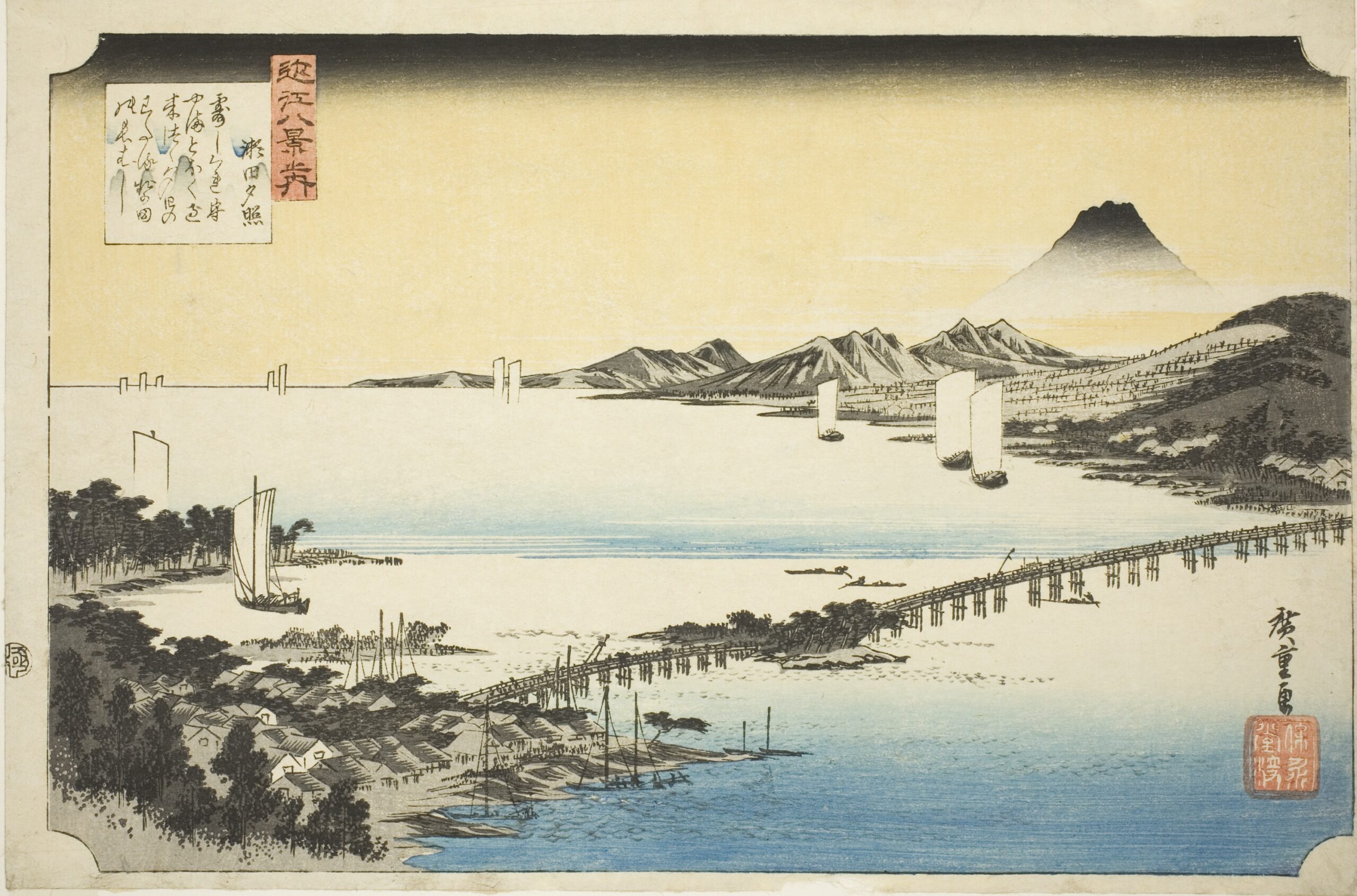
One of Hiroshige’s defining qualities is spatial layering.
Foreground branches frame distant mountains.
Bridges stretch from edge to edge.
Riverbanks recede into haze.
The viewer stands neither inside nor outside the scene —
but slightly removed.
That distance creates calm.
Even when figures labor,
even when storms approach,
there is restraint.
Hiroshige does not dramatize hardship.
He observes it.
Everyday Japan, Without Ornament
Fishermen pulling nets.
Travelers warming themselves at roadside inns.
Villages tucked beneath hills.
Hiroshige’s Japan feels lived in.
It is neither heroic nor tragic.
It is continuous.
His prints suggest that life unfolds quietly —
not in singular events,
but in repeated crossings,
daily journeys,
seasonal shifts.
Why Hiroshige Still Matters
In a modern world defined by velocity and spectacle,
Hiroshige offers something rare:
measured attention.
He invites us to slow down.
To notice how light falls on water.
How snow absorbs sound.
How distance softens urgency.
His art reminds us that travel is not only about destination.
It is about the changing sky above the road.
And perhaps that is why Hiroshige endures —
not as a chronicler of grand events,
but as a quiet architect of atmosphere.
In his world,
nothing explodes.
Nothing demands.
The rain falls.
The bridge stands.
The traveler continues.
And the season turns.

コメント