Utagawa Hiroshige did not paint the world as something to conquer.
He painted it as something already alive.
While many artists of the Edo period focused on people, drama, or power,
Hiroshige turned his attention to roads, weather, rivers, and distance.
Not as backgrounds — but as the main subject.
His landscapes are quiet, yet never empty.
Seeing Time Instead of Events
Hiroshige’s most famous works, such as The Fifty-Three Stations of the Tōkaidō and The Sixty-Nine Stations of the Kisokaidō, are often described as travel series.
But they are not records of destinations.
They are records of passing time.
Rain begins suddenly.
Snow muffles sound.
A bridge disappears into mist.
In Hiroshige’s prints, nothing dramatic needs to happen.
The weather itself is the event.
Nature as a Living Presence
Mountains in Hiroshige’s work do not dominate.
Rivers do not threaten.
Instead, nature observes.
Figures are small.
Roads stretch longer than expected.
The horizon often feels just out of reach.
This balance makes the viewer slow down.
You do not look at a Hiroshige print.
You move into it.
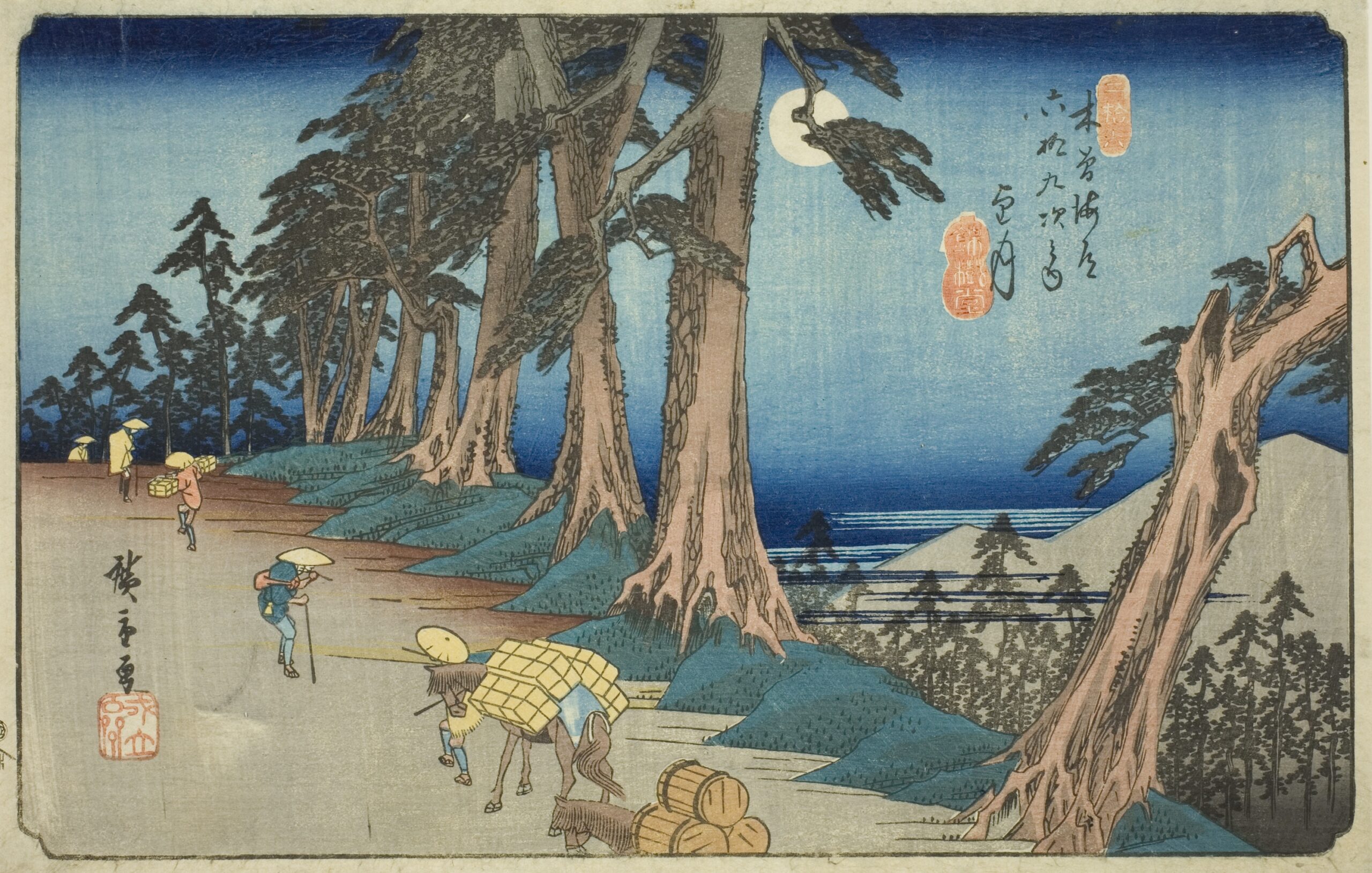
Mochizuki Yokkaichi (Fourth Station), from The Fifty-Three Stations of the Tōkaidō

Silence as Design
One of Hiroshige’s greatest strengths is restraint.
Colors are soft.
Compositions are open.
Negative space is allowed to exist.
Snow scenes, night crossings, sudden rain showers —
these moments feel almost modern in their minimalism.
Hiroshige understood that silence is not absence.
It is structure.
Today, Hiroshige’s work resonates deeply.
In a world filled with constant movement and noise,
his prints offer something rare:
- A road with no urgency
- A traveler without a destination
- A moment that does not ask to be shared
He reminds us that beauty does not require explanation.
Sometimes, it only requires attention.
A Quiet Legacy
Hiroshige passed away believing his work was unfinished.
Yet his influence spread far beyond Edo.
From Japanese painters to European Impressionists,
his sense of atmosphere and framing reshaped how landscapes were seen.
But perhaps his greatest legacy is simpler:
He taught us how to look —
and how to pause.

コメント