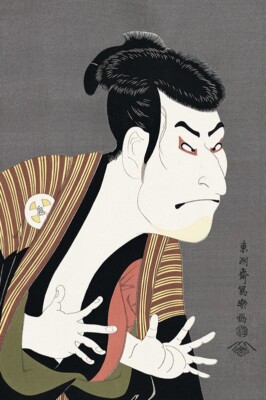
In the late Edo period, a mysterious artist emerged without warning and disappeared just as abruptly. His name was Tōshūsai Sharaku.
Unlike other ukiyo-e artists who pursued beauty and elegance, Sharaku painted something far more unsettling: faces caught in tension, distortion, and raw emotion.
His works feel less like portraits and more like moments of exposure.
Faces That Refused to Please
Sharaku is best known for his portraits of kabuki actors. But these were not flattering images designed to celebrate celebrity. Instead, he exaggerated expressions, emphasized awkward gestures, and captured fleeting emotions such as arrogance, fear, hesitation, and obsession.
At a time when ukiyo-e audiences favored idealized beauty, Sharaku showed psychological truth.
Many viewers in Edo found his prints disturbing. Some reportedly laughed. Others rejected them outright. Sales were poor, and within less than a year, Sharaku vanished from the art world.
A Style Too Modern for Its Time
What makes Sharaku extraordinary is how modern his work feels even today.
- Extreme close-ups that dominate the frame
- Cropped compositions that heighten tension
- Bold contrasts and distorted anatomy
- A focus on inner emotion rather than outer beauty
These qualities resemble techniques found in modern photography, cinema, and even psychological illustration—centuries before they became common.
Sharaku did not aim to please the viewer.
He aimed to reveal.
Who Was Sharaku?
No one knows for certain.
The most accepted theory suggests that Sharaku was a Noh actor, temporarily active in ukiyo-e. Others believe he was a collective, a disgraced samurai, or an artist protected by anonymity. His sudden disappearance remains unexplained.
This mystery only deepens the impact of his work.
Sharaku did not build a career.
He left a rupture in art history.
Why Sharaku Still Matters
Sharaku’s portraits confront us with an uncomfortable idea:
that art does not need to be beautiful to be honest.
In an age of polished images and curated identities, Sharaku’s work reminds us that faces reveal more than we intend. His prints feel alive because they capture the moment when control slips.
They are not portraits of actors.
They are portraits of being watched.
From Ukiyo-e to Puzzle: Seeing Sharaku Slowly
Sharaku’s work rewards slow observation. Details in the eyes, hands, and posture emerge only with time. This is why his art translates remarkably well into jigsaw puzzles, where the act of assembling mirrors the act of looking carefully.
Each piece becomes a fragment of expression.
Each pause invites reflection.

Final Thought
Sharaku appeared, shocked his contemporaries, and disappeared—
but his gaze never left us.
In his distorted faces, we see something timeless:
the moment when the mask fails.
If you’d like, I can also:
- Add video embed + product placement instructions for WordPress
- Write a shorter version for email or social media
- Adapt this article for SEO or a darker “Supernatural Zone” tone
コメント