In the art of Katsushika Hokusai, the sea is never merely background.
It breathes, moves, and shapes the lives of those who depend upon it.
Hokusai lived during Japan’s Edo period, a time when travel expanded and landscapes became central themes in art. While many artists depicted famous places as landmarks, Hokusai approached the natural world differently. His compositions rarely feel static. Waves curl forward, boats lean into the wind, and distant mountains hold their quiet presence against a shifting sky.
Perhaps the most recognizable image in Japanese art is The Great Wave off Kanagawa. At first glance, the scene appears dramatic—boats struggle beneath a towering wave, while Mount Fuji rests quietly on the horizon. Yet the power of the image lies not in chaos but in balance. The wave arches like a claw above the fishermen, but the composition is measured and precise. The mountain remains calm, unchanged by the turmoil of the sea.
This tension between movement and stillness appears throughout Hokusai’s work.
In Kajikazawa in Kai Province, a lone fisherman stands on a rocky outcrop, casting his line into rushing water. His body leans forward, fully engaged with the current. Yet beyond him, Mount Fuji rises quietly in the distance. Human effort and natural permanence exist side by side.
Another work, Fine Wind, Clear Morning, presents a completely different mood. Here there is no movement at all—only the silent strength of Fuji illuminated by morning light. The mountain becomes monumental, almost abstract, its red surface glowing against the sky.
These contrasts reveal something essential about Hokusai’s vision. Nature is powerful, but it is not hostile. The sea may surge, winds may rise, and rivers may rush forward, yet these forces belong to a larger rhythm. Human life unfolds within that rhythm rather than against it.
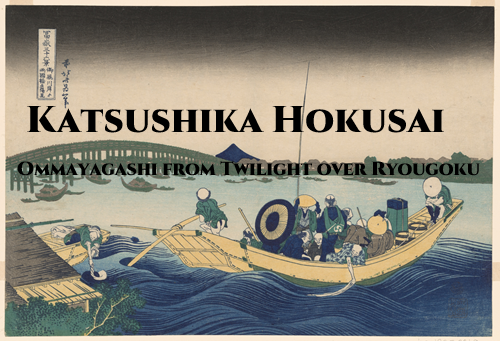
Hokusai’s landscapes are also deeply connected to travel. Roads, rivers, and coastal routes were the arteries of Edo-period Japan. Merchants, pilgrims, and fishermen moved constantly between regions. His prints capture these movements—boats crossing wide bays, travelers walking along mountain paths, villages appearing quietly along the shoreline.

Yet Hokusai rarely focuses on the journey’s destination. Instead, he pauses within the journey itself.
A boat approaching shore.
A wave forming before it breaks.
A fisherman leaning over water at dawn.
These moments feel suspended between action and stillness.
Part of the reason Hokusai’s art resonates so strongly today is the clarity of his compositions. Each print is carefully structured. Diagonal waves lead the eye across the image. Boats form repeating lines that echo the motion of water. Even empty space—the open sky or distant horizon—becomes an active element in the design.
This structural clarity allowed Hokusai’s work to travel far beyond Japan. When Japanese woodblock prints reached Europe in the nineteenth century, artists such as Claude Monet and Vincent van Gogh were captivated by their composition and bold perspective. The influence of ukiyo-e helped reshape Western painting, introducing new approaches to color, framing, and asymmetrical balance.
Despite this global impact, Hokusai’s subjects remain grounded in everyday life.
Fishermen hauling nets.
Villagers crossing bridges.
Boats working against the tide.
The world he depicts is not mythical. It is practical, lived, and closely tied to the rhythms of nature.
And yet, within these ordinary scenes, Hokusai finds something timeless.
A single wave becomes monumental.
A distant mountain becomes eternal.
A small boat becomes the measure of human persistence.
More than two centuries later, these images still feel alive.
They remind us that the sea is never truly quiet—but within its motion there is order, balance, and breath.
コメント