
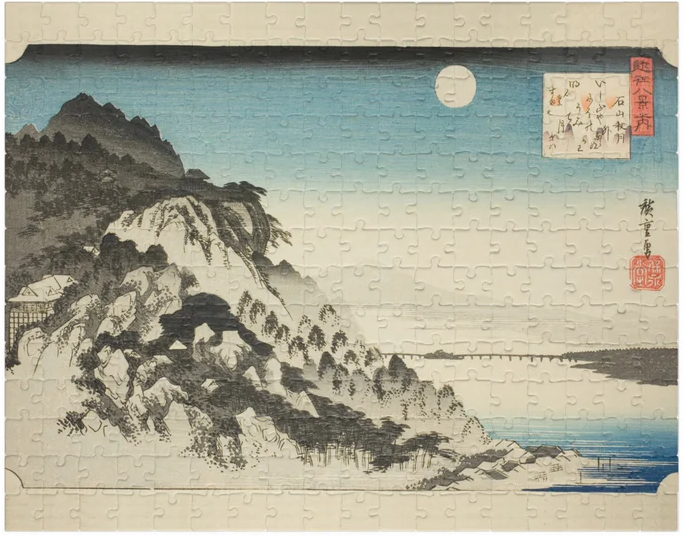
Among the most poetic landscapes created by Utagawa Hiroshige, Autumn Moon at Ishiyama reveals how silence itself can become the subject of art.
This print belongs to the classical landscape theme Eight Views of Ōmi, a group of scenes centered around Lake Biwa.
For centuries, these locations were celebrated in poetry and painting. Each view captures not just a place, but a particular atmosphere — a moment when landscape, season, and time of day align.
In this composition, Hiroshige chooses one of the most contemplative settings:
the autumn moon rising above Ishiyama-dera.
A Temple Above the Lake
Ishiyama Temple stands on a dramatic rocky cliff overlooking the southern edge of Lake Biwa.
In Japanese cultural history, the temple has long been associated with literature and moon viewing. According to tradition, the famous writer Murasaki Shikibu began writing The Tale of Genji while observing the autumn moon from this very temple.
Hiroshige’s print does not attempt to narrate this history directly. Instead, the temple appears quietly among trees and rocks, partially hidden within the mountainside.
It watches the lake.
From this elevated point, the landscape opens outward into distance.
The water stretches across the horizon.
Mountains dissolve into pale mist.
The sky remains clear and calm.
And above everything, the moon rises.
Composition and Contrast
One of the most striking aspects of this print is Hiroshige’s use of contrast.
The foreground cliff is dark, textured, and almost monumental. Its rugged forms dominate the left side of the image. The rocks appear ancient, solid, and close to the viewer.
Beyond them, however, the landscape transforms.
The lake becomes smooth and luminous.
The distant mountains fade into atmosphere.
The horizon line softens until it nearly disappears.
Between these two worlds — earth and distance — hangs the moon.
Hiroshige positions the moon slightly off-center, allowing the eye to travel from the cliff, across the lake, and upward into the open sky.
The result is a composition that feels both grounded and expansive.
The Poetry of the Moon
The theme of “Autumn Moon at Ishiyama” originates from classical Chinese and Japanese poetry traditions.
In East Asian aesthetics, autumn is the season most closely associated with the moon. The air becomes clear, the sky deepens, and the moon appears especially bright.
Moon viewing — tsukimi — became a refined cultural practice among poets and aristocrats.
People gathered to observe the moon reflected in water, writing poetry and contemplating the passage of time.
Hiroshige captures this tradition without showing any human figures.
There are no poets.
No gatherings.
No rituals.
Instead, the landscape itself performs the meditation.
The moon shines quietly above the lake.
The temple observes from the cliff.
Nature becomes the witness.
Atmosphere Over Action
Unlike many Western landscape traditions that emphasize dramatic events, Hiroshige often focuses on atmosphere.
His landscapes are rarely about what happens.
They are about what is felt.
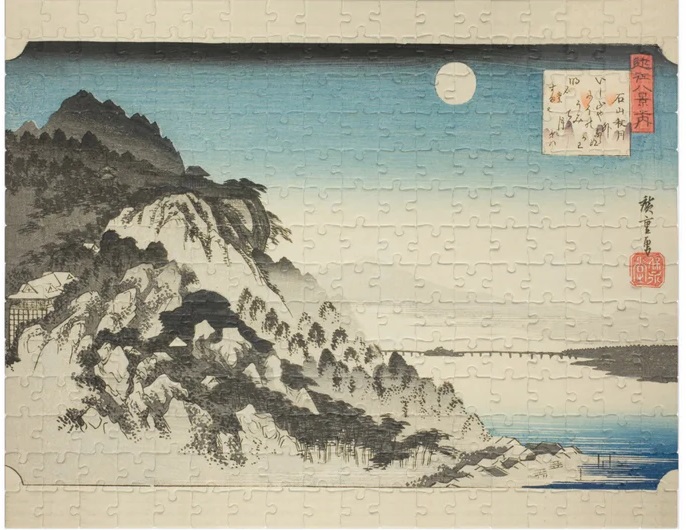
In Autumn Moon at Ishiyama, nothing dramatic occurs.
No storm approaches.
No travelers appear.
No boats cross the water.
The entire scene rests in a moment of stillness.
This stillness is intentional.
It invites the viewer to pause — to look slowly across the lake and experience the same quiet contemplation that visitors to Ishiyama Temple may have felt for centuries.
Hiroshige’s Vision of Landscape
Throughout his career, Hiroshige transformed the tradition of landscape printmaking.
Rather than presenting landscapes as static scenery, he treated them as environments filled with weather, light, and changing atmosphere.
Mist, rain, twilight, and moonlight appear frequently in his work.
These conditions soften the boundaries between objects. Mountains fade. Water reflects sky. Distance becomes emotional rather than purely geographical.
In Autumn Moon at Ishiyama, this philosophy reaches a refined simplicity.
The lake does not dominate the scene.
The temple does not command attention.
Even the moon appears quietly.
Everything exists in balance.
The Enduring Calm of Hiroshige
More than a century and a half after its creation, Autumn Moon at Ishiyama continues to resonate with viewers around the world.
The print reminds us that landscape can be more than a depiction of nature.
It can be a reflection of inner stillness.
Hiroshige does not ask us to admire the scene.
He asks us to enter it.
To stand beside the temple on the rocky cliff.
To watch the moon rise above Lake Biwa.
And to experience the quiet moment when the world becomes calm.
If you’d like, I can also create:
- A series of 10 Hiroshige blog articles (optimized for your Ukiyo-e Library series)
- SEO titles + WordPress meta descriptions
- Internal linking structure for your Ukiyo-e Library site
This would help strengthen the “accumulation phase” of your Ukiyo-e Library project that you mentioned earlier.

コメント