
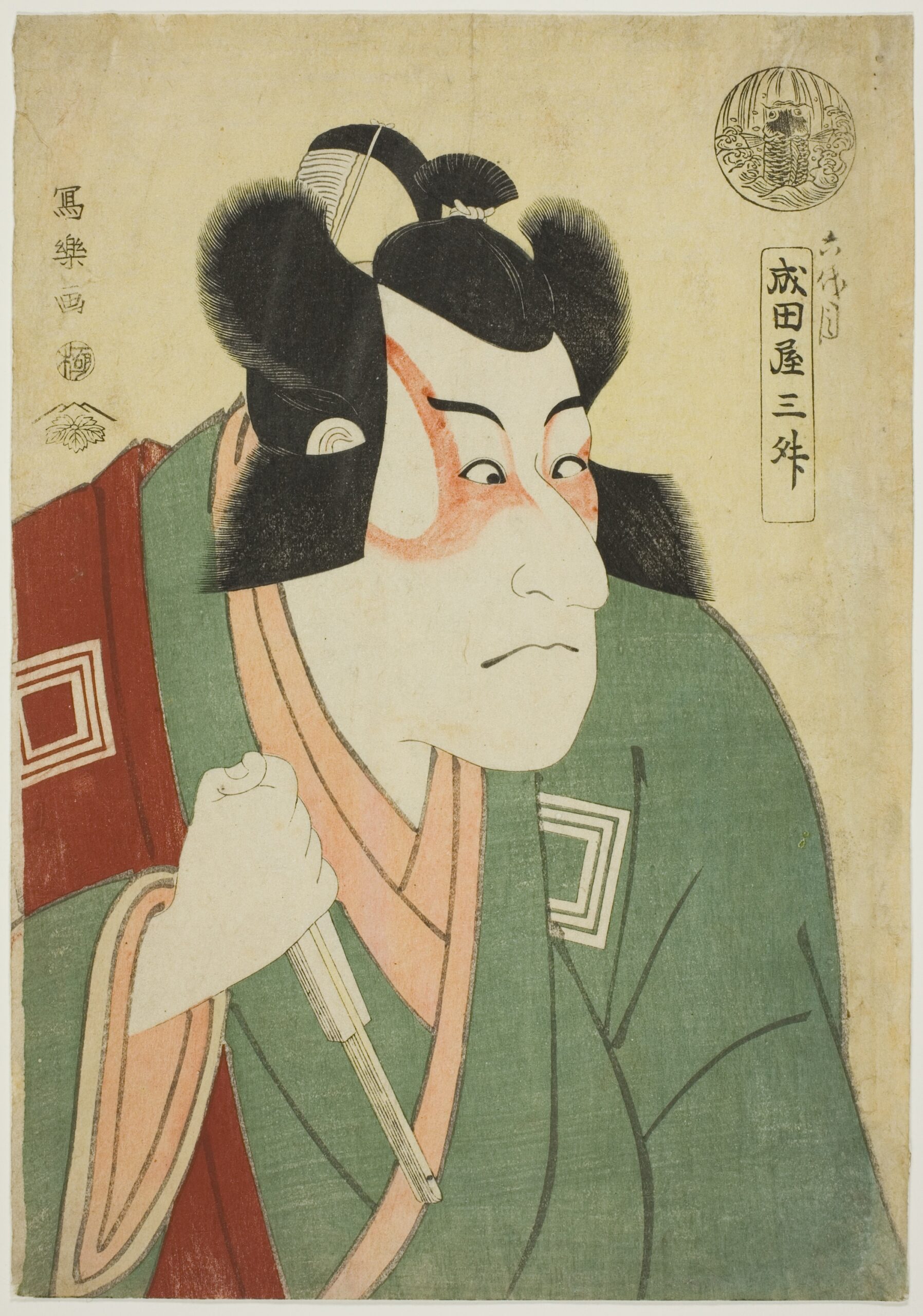
Among the masters of ukiyo-e, Tōshūsai Sharaku stands apart.
Not because of longevity.
Not because of volume.
But because of silence.
Sharaku’s entire known body of work appeared suddenly in 1794 — and disappeared just as quickly, within less than a year. In that brief window, he produced some of the most unsettling and psychologically direct portraits in Japanese art history.
Faces Without Politeness
While other ukiyo-e artists idealized beauty or softened expression, Sharaku did the opposite.
His kabuki actors are shown mid-gesture, mid-breath — brows tightened, mouths uneven, eyes heavy with strain. These are not heroic masks. They are human faces under pressure.
Sharaku did not flatter his subjects.
He observed them.
In doing so, he broke an unspoken rule of popular art: performers were meant to be admired, not exposed.

A Public That Looked Away
The reaction was swift.
Sharaku’s prints did not sell well. Audiences found them uncomfortable. Actors themselves may have disliked what they saw — reflections not of their roles, but of the effort behind them.
Within months, Sharaku vanished from the publishing world.
No farewell.
No explanation.
No continuation.
An Artist Defined by Absence
Unlike Hokusai or Hiroshige, Sharaku left no long career to trace. There are no late works, no stylistic evolution to follow.
What remains is a single, concentrated moment of vision.
Some historians speculate that Sharaku may have been a Noh actor, accustomed to restraint and discipline. Others suggest he worked under a pseudonym, or that external pressures forced his withdrawal.
None of this is certain.
And perhaps that uncertainty is the point.
Why Sharaku Still Matters
Sharaku’s portraits feel modern because they refuse comfort.
They remind us that art does not always exist to please. Sometimes it exists to reveal — to hold up a mirror before we are ready to look.
In a culture that often celebrates harmony, Sharaku documented tension.
In a medium built on popularity, he chose honesty.
A Quiet Legacy
Sharaku did not build a legacy through time.
He built it through intensity.
A short appearance.
A sharp gaze.
And then, silence.
More than two centuries later, his faces still stare back at us —
unapologetic, unfinished, and impossible to forget.
🏷️ Tags (comma-separated)
Sharaku, Toshusai Sharaku, Ukiyo-e, Japanese Art, Kabuki Actors, Edo Period, Ukiyo-e Library, Japanese Woodblock Prints, Art History

コメント