
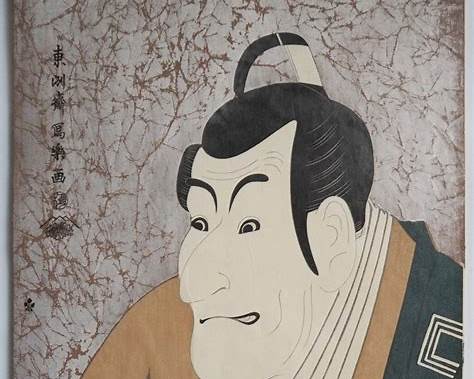
Among all ukiyo-e artists, Toshusai Sharaku stands apart as the most unsettling—and perhaps the most modern.
Active for only a brief moment around 1794–1795, Sharaku left behind portraits that do not flatter, idealize, or beautify. Instead, they confront the viewer.
Wrinkled brows, distorted mouths, piercing eyes—Sharaku’s actors seem frozen at the peak of emotion, as if we have interrupted something private and intense. These are not just portraits of kabuki performers; they are psychological studies.
A Short-Lived Artist, an Endless Mystery
Sharaku’s career lasted less than a year. Then—silence.
No clear records of his birth.
No confirmed death.
No definitive identity.
Some theories claim he was a Noh actor, others suggest a samurai, or even a collective of artists working under one name. This sudden appearance and disappearance only deepens the unease his works create.
Unlike other ukiyo-e masters who celebrated beauty or landscapes, Sharaku focused on inner tension—fear, arrogance, obsession, cruelty, pride.
Why Sharaku Feels So Modern
Sharaku’s portraits feel shockingly contemporary.
They resemble modern cinema close-ups or psychological thrillers rather than 18th-century art.
- Faces are cropped tightly, forcing intimacy
- Expressions are exaggerated but emotionally precise
- The viewer feels watched, judged, almost accused
It is no exaggeration to say Sharaku anticipated modern portraiture by over a century.
🎥 Short Video: “The Gaze That Should Not Exist”
This short video introduces Sharaku as a psychological anomaly in Edo art—an artist who painted not what people wanted to see, but what they could not avoid seeing.
The video works as an emotional hook before the transition to tangible art objects.
From Ukiyo-e to Jigsaw Puzzle: Confronting Sharaku, Piece by Piece
Sharaku’s works are not easy to look at—and that is precisely why they are powerful as puzzles.
Turning a Sharaku portrait into a jigsaw puzzle transforms the experience:
- Each fragment becomes an eye, a wrinkle, a shadow
- The act of assembling mirrors the act of decoding the face
- The final image feels earned, not merely observed
Unlike decorative art, Sharaku’s puzzles demand attention and patience.
🧩 Product Introduction: Sharaku Ukiyo-e Jigsaw Puzzle
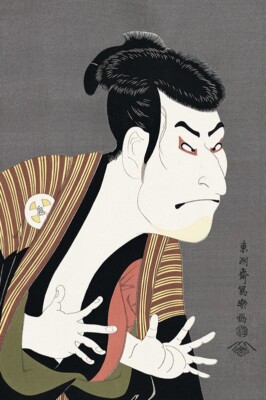
Product highlights:
- Authentic Sharaku portrait artwork
- Available in multiple piece counts (from casual to expert)
- High-resolution printing preserving dramatic expressions
- Designed for collectors of Japanese art and psychological imagery
This is not a relaxing puzzle—it is a dialogue with the past.
Why Sharaku Still Matters Today
In a world saturated with idealized images and filters, Sharaku feels brutally honest.
His figures are flawed, emotional, sometimes grotesque—but undeniably human.
Sharaku reminds us that art does not exist only to please.
Sometimes, it exists to disturb, to question, and to linger in the mind long after we look away.
If ukiyo-e is the floating world, then Sharaku shows us what sinks beneath its surface.


コメント