The Edo stage was luminous.
Kabuki actors were icons —
celebrated, admired, idealized.
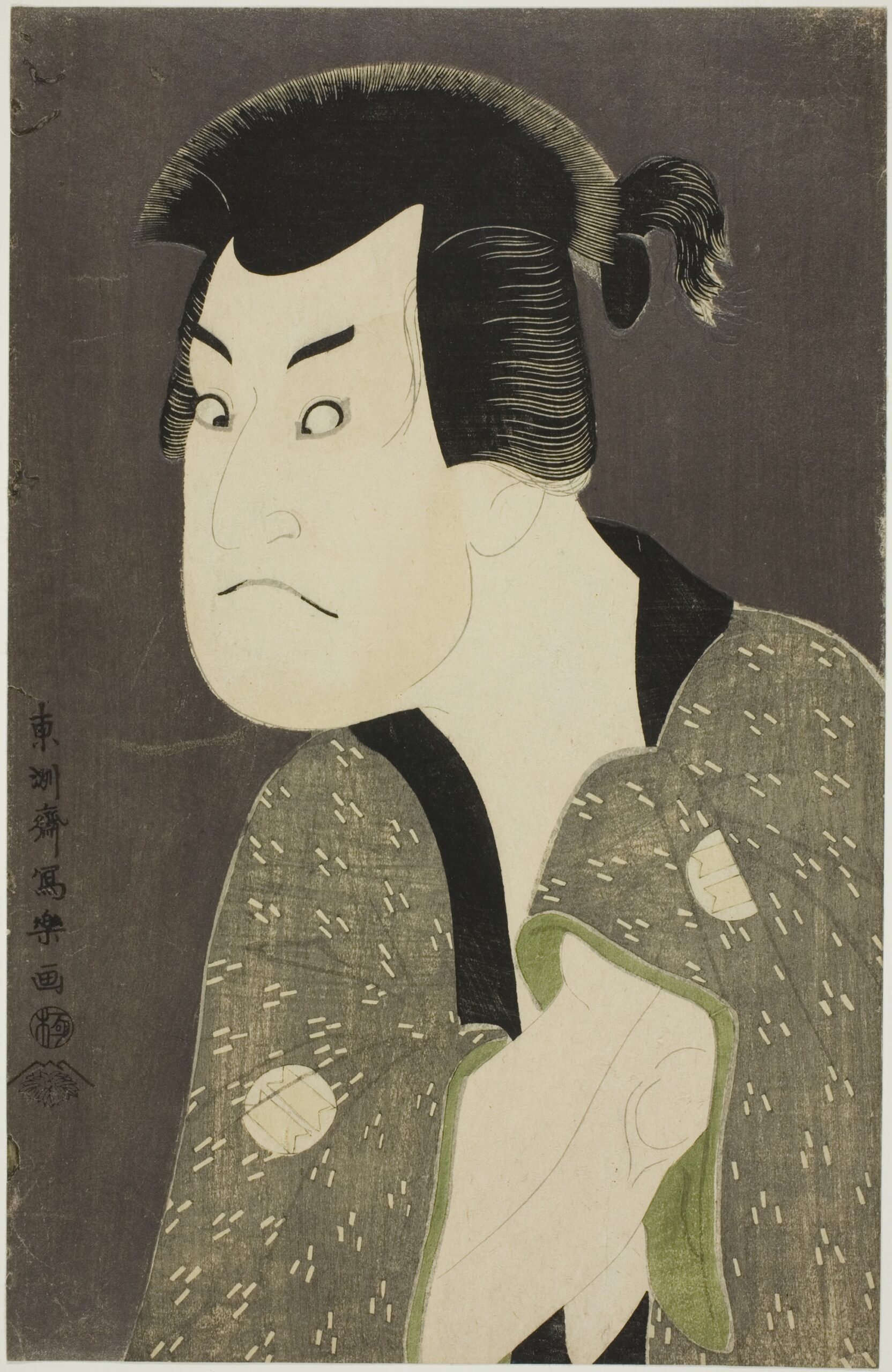
But Tōshūsai Sharaku did not paint admiration.
He painted tension.
In his portraits, the eyes are sharpened.
The mouth tightens.
The cheekbones hold a trace of strain.
There is no glamour here.
No polished heroism.
Instead, Sharaku captures the moment between performance and exposure —
the instant when a role feels almost too heavy to hold.
His career lasted less than a year.
From 1794 to 1795, he appeared suddenly —
and then vanished.
Such brevity only deepens the mystery.
Some believe he was a Noh actor.
Others suggest he was an artistic experiment.
No certainty remains.
But the faces remain.
Unlike many ukiyo-e artists who idealized their subjects,
Sharaku seemed to dissect them.

He exaggerated not to beautify,
but to reveal.
The backgrounds are minimal.
The compositions direct everything toward the face.
And the face looks back.
Sharaku’s portraits do not entertain.
They confront.
Are we seeing the actor —
or the fragile human beneath the mask?
In a culture where ukiyo-e prints were meant to celebrate celebrity,
Sharaku’s works feel almost unsettling.
They are not decorative.
They are psychological.
The stage performance ends.
The applause fades.
But the gaze lingers.
More than two centuries later,
those eyes still search the viewer —
quiet, unyielding, and strangely modern.
Sharaku did not paint for long.
Yet in that brief intensity,
he created something enduring:
Not the illusion of performance —
but the moment it trembles.


コメント