
Introduction
Ukiyo-e is often introduced as “pictures of the floating world,”
a genre famous for beautiful women, kabuki actors, and scenes of urban pleasure.
Yet beyond the theaters and pleasure quarters, another world quietly emerged —
the world of landscapes.
Mountains, rivers, bridges, snow, rain, and wind became more than backgrounds.
In ukiyo-e landscape prints, nature itself began to tell stories.
This journal explores how Edo-period artists transformed ordinary scenery into timeless narratives.
The Birth of Landscape Ukiyo-e
Before the 19th century, landscapes were rarely the main subject of ukiyo-e.
They existed only as supporting elements behind people.
Everything changed with artists such as Hokusai and Hiroshige.
They shifted the focus:
- From people → to nature
- From moments → to journeys
- From entertainment → to contemplation
Roads, seasons, and weather became central characters.
Landscape prints were no longer just images —
they were experiences.
Nature as a Living Presence

What makes ukiyo-e landscapes unique is not realism, but emotion.
Rain slants across a bridge.
Snow muffles a village at night.
Waves rise like living creatures.
Nature in ukiyo-e is never passive.
It:
- Moves
- Threatens
- Comforts
- Observes human life
Small travelers crossing a vast landscape remind us of human fragility —
and continuity.
The Journey Motif
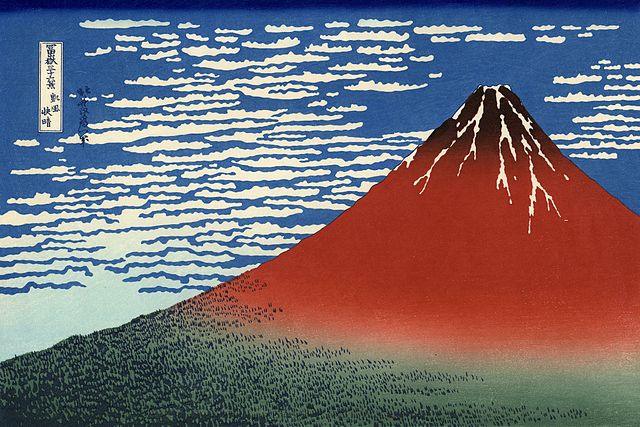
Many famous landscape series are built around travel.
Not as adventure, but as routine.
Merchants, pilgrims, and messengers walked the same roads again and again.
Artists captured these repetitive journeys, turning them into visual poetry.
A single bridge could represent:
- Departure
- Return
- Transition
- Impermanence
Landscape prints became maps of memory.
Why Ukiyo-e Landscapes Still Matter
Today, these images continue to resonate because they speak quietly.
They do not demand attention.
They invite it.
In a fast, digital world, ukiyo-e landscapes offer:
- Stillness
- Rhythm
- Perspective
They remind us that beauty often exists in the ordinary —
if we learn how to look..
Closing Thoughts
Ukiyo-e landscapes are not just historical artifacts.
They are conversations between nature and humanity, frozen in time.
This journal will continue exploring:
- Famous landscapes
- Hidden symbolism
- Artists and their journeys
- The stories behind each scene
The road has just begun.
Explore Ukiyo-e Through Art & Craft
If you would like to experience ukiyo-e landscapes beyond the screen,
we curate a collection of premium jigsaw puzzles inspired by iconic Japanese prints.
Each puzzle is designed as a slow, tactile journey —
much like walking the roads and bridges of Edo Japan.
🔗 Official Store: https://jigsawjapan.com
🎁 Free Gift for Readers
As a thank-you for reading,
we offer a free digital booklet exploring Japanese art, nature, and quiet ways of seeing.
This is not a newsletter.
You will receive the gift only once, with no automatic emails.
How to receive the free gift:
Simply send a short email with the word “Ukiyo-e” to:
📩 present@ma3.fun
We will reply with the download link.

コメント