
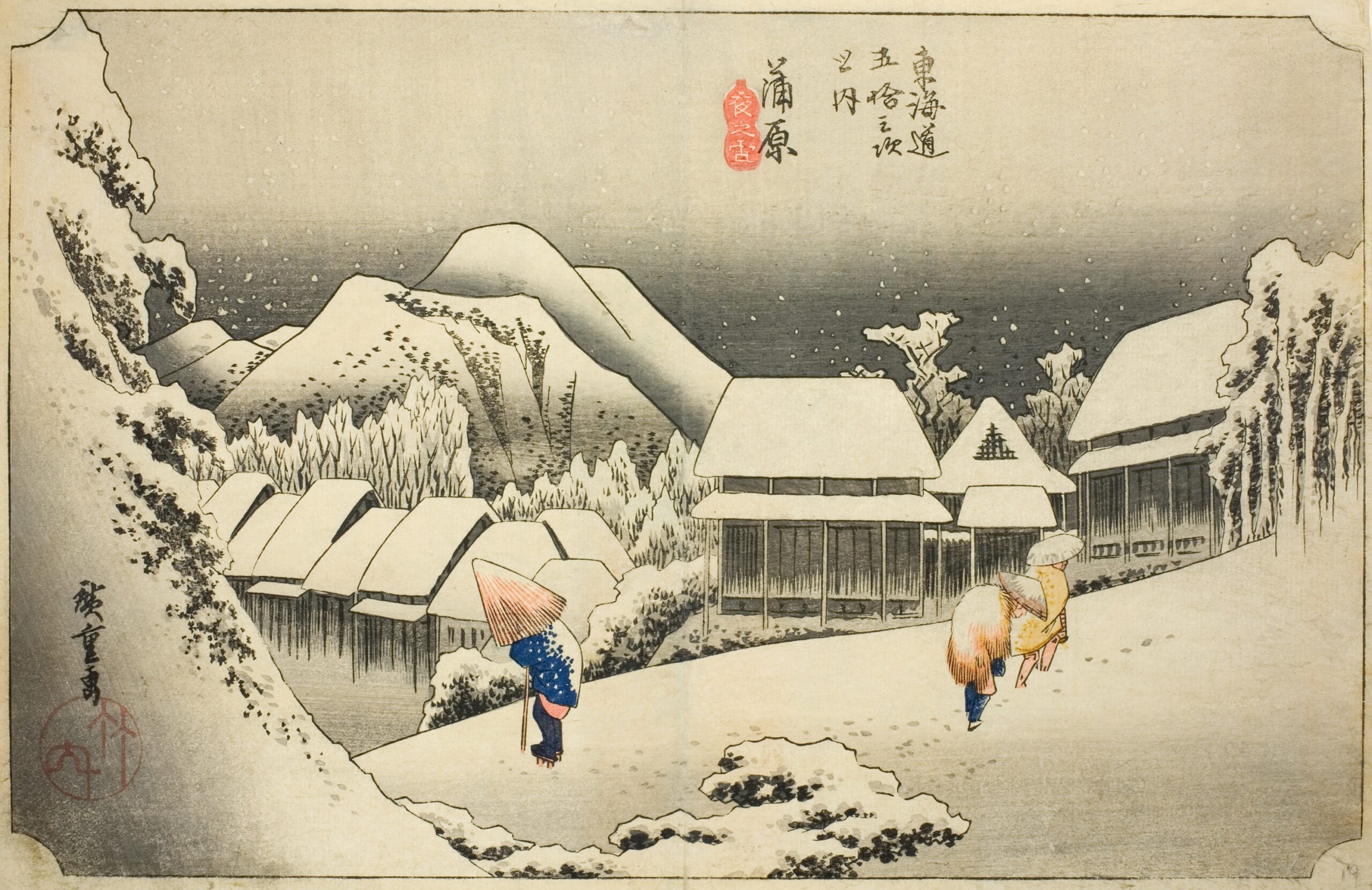
When people think of ukiyo-e, they often imagine dramatic waves, heroic figures, or bold compositions. Utagawa Hiroshige, however, followed a quieter path.
His art does not shout — it whispers.
Hiroshige was an Edo-period ukiyo-e master best known for his landscape prints. Rather than focusing on legendary heroes, he depicted weather, roads, rivers, and ordinary people. His works feel less like pictures and more like moments in time, gently preserved on paper.
The Fifty-three Stations of the Tōkaidō — A Road as a Story
Hiroshige’s most famous series, The Fifty-three Stations of the Tōkaidō, portrays the great highway connecting Edo (modern Tokyo) and Kyoto.
But this is not a simple travel guide.
Along the road we encounter:
- Travelers caught in sudden rain
- Porters crossing rivers with quiet determination
- Villages resting under evening skies
Each print captures movement and pause at the same time, allowing the viewer to step into the journey. The road itself becomes the main character.
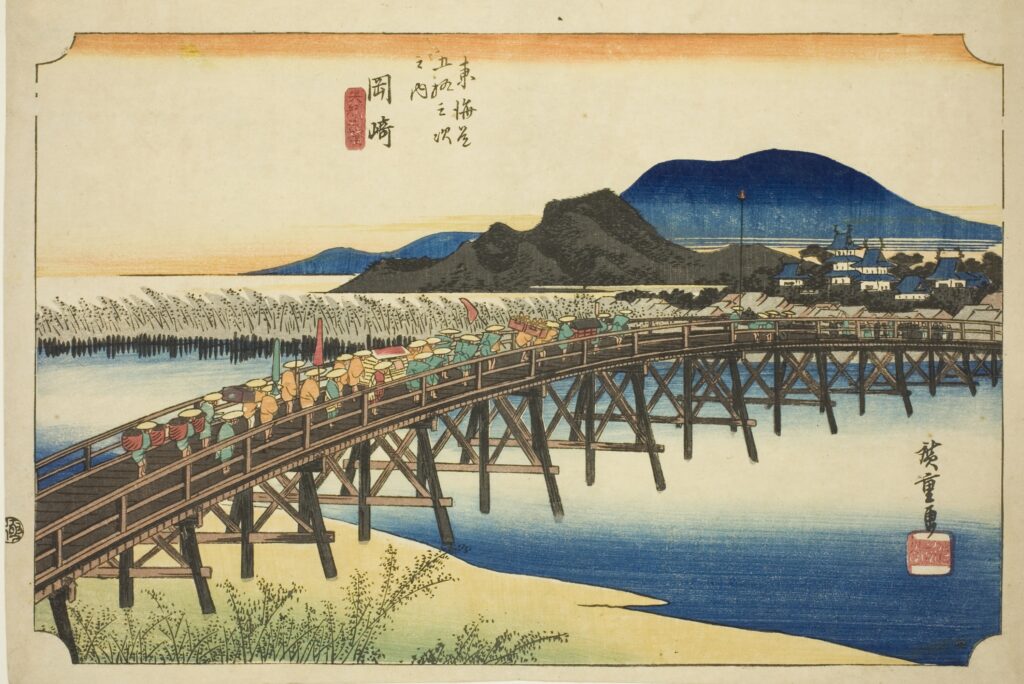
Rain, Snow, and Night — Hiroshige’s Signature
One of Hiroshige’s greatest achievements is his mastery of atmosphere.
Slanting rain, deep snowfall, misty mornings, and moonlit nights appear again and again in his works.
In series such as One Hundred Famous Views of Edo, the same city transforms endlessly through seasons and weather. Hiroshige was not simply painting places — he was painting how those places feel at a specific moment.
This sensitivity to time gives his landscapes a deeply emotional quality, often described as calm, nostalgic, or quietly moving.
Hiroshige and Hokusai — Stillness and Power
Compared with his contemporary Katsushika Hokusai, the contrast is striking.
- Hokusai emphasizes energy, force, and dramatic structure
- Hiroshige favors balance, silence, and human scale
Where Hokusai confronts nature, Hiroshige walks within it. This difference is why many viewers find Hiroshige’s works especially soothing and meditative.
Experiencing Hiroshige Through Jigsaw Puzzles
Hiroshige’s landscapes are particularly well suited to jigsaw puzzles.
As you assemble each piece, the journey unfolds slowly — sky first, then water, then distant figures on the road.
- Subtle color transitions become more noticeable
- Paths and rivers guide the eye naturally
- Human presence appears quietly, piece by piece
The finished puzzle is not just an image, but a journey completed by hand.
Conclusion — A Quiet Road That Still Awaits
Utagawa Hiroshige offers us something rare in the modern world:
the invitation to slow down.
His roads stretch endlessly, his rain continues to fall, and his travelers move forward without urgency. More than two centuries later, his landscapes still breathe.
When life feels rushed, step onto Hiroshige’s road.
You may find that the calm you seek has been waiting there all along.

コメント