
Utamaro and the Art of Seeing
In the floating world of Edo, actors dazzled, warriors posed, and landscapes expanded toward distant horizons.
But Kitagawa Utamaro chose something closer.
He chose the face.
Not as decoration —
but as psychology.
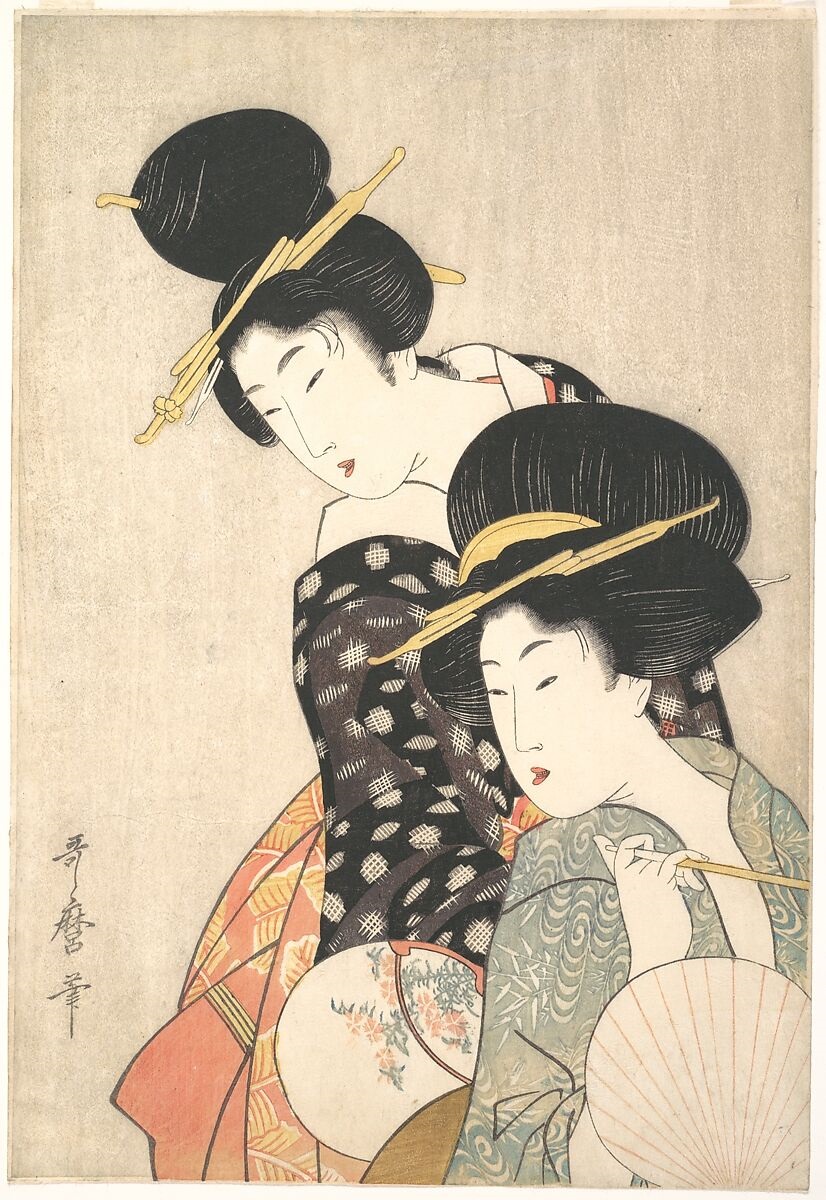
Utamaro’s bijin-ga, or “pictures of beautiful women,” are not portraits of individuals in the Western sense. They are studies of mood, posture, thought. A lowered eyelid. A half-hidden smile. A hand resting lightly against fabric.
Where other artists celebrated spectacle, Utamaro explored intimacy.
Beauty Beyond Ornament
In works such as Three Beauties of the Present Day, Utamaro presents three women not as competing ideals, but as variations of presence. Their faces are elongated, their necks refined, their expressions reserved.
They are not performing for the viewer.
They are existing.
The elegance lies in restraint —
in what is almost said,
but not spoken.
Utamaro refined the close-up composition in ukiyo-e, cropping figures at unexpected angles, bringing viewers into a proximity that feels modern even today.

Light, Line, and Emotional Distance
Utamaro’s line is delicate but decisive.
His use of mica backgrounds adds subtle radiance.
Patterns in kimono are never random; they frame the emotional center of the figure.
Unlike dramatic narrative prints, his compositions breathe.
Space surrounds the subject.
Silence accompanies the gaze.
There is often a slight emotional distance — a feeling that the woman in the image is thinking of something beyond the frame.
This distance is the power.
Influence Beyond Edo
Utamaro’s influence reached Europe in the 19th century, where artists of Impressionism and Art Nouveau studied his compositions. The idea that a moment, a gesture, or a quiet expression could hold meaning without grand storytelling was revolutionary.
He did not need movement.
He needed attention.
A Quiet Legacy
Utamaro’s world was not built on noise.
It was built on observation.
He showed that beauty is not simply ornament.
It is atmosphere.
To look at a Utamaro print is to pause —
to recognize that expression can be as powerful as action.
In the floating world, everything changes.
But the human gaze remains.
And Utamaro understood that better than most.


コメント